“We Bought the Copilot. Why Is Nothing Happening?”
Why enterprise AI licences are becoming the fastest-growing category of shelfware — and what leaders can do before the next renewal cycle.
The meeting usually happens sometime in the fourth quarter. The CFO opens the invoice, multiplies thirty dollars a month by the number of seats, and asks the CIO the question that should have been asked eighteen months ago: “What are we actually getting from this?”
In a 5,000-seat enterprise, a full Microsoft 365 Copilot deployment runs roughly $1.8 million a year before training, change management, or integration costs. Comparable numbers apply to Salesforce Einstein, Adobe Firefly, ServiceNow AI, and the growing stack of AI add-ons that every major SaaS vendor now sells. The licences are deployed. The dashboards show healthy provisioning. And yet when the CFO asks what measurable business outcome has shifted, the CIO usually cannot answer cleanly.
This is the activation problem — and in 2026, it is the single largest source of invisible AI waste in the enterprise. A July 2025 Morgan Stanley / RSM AI Adopter Survey found that 79% of enterprises have deployed Microsoft Copilot, but 74% of companies using AI tools still cannot show tangible business value. The gap between buying AI and absorbing it is where most AI budgets are quietly being burnt.
📊 Leadership Signal: The gap between buying AI and absorbing it is where most AI budgets are quietly being burnt.
The shelfware is real, and the numbers now exist
Until recently, AI shelfware was hard to measure. In 2026, the data is hardening. Morgan Stanley and RSM’s research across large enterprises shows a consistent pattern: among organisations with more than 1,000 employees, only around 55% of deployed AI licences are actively used on a weekly basis. Roughly half the AI spend produces roughly zero of the AI activity. The variation across industries is striking:
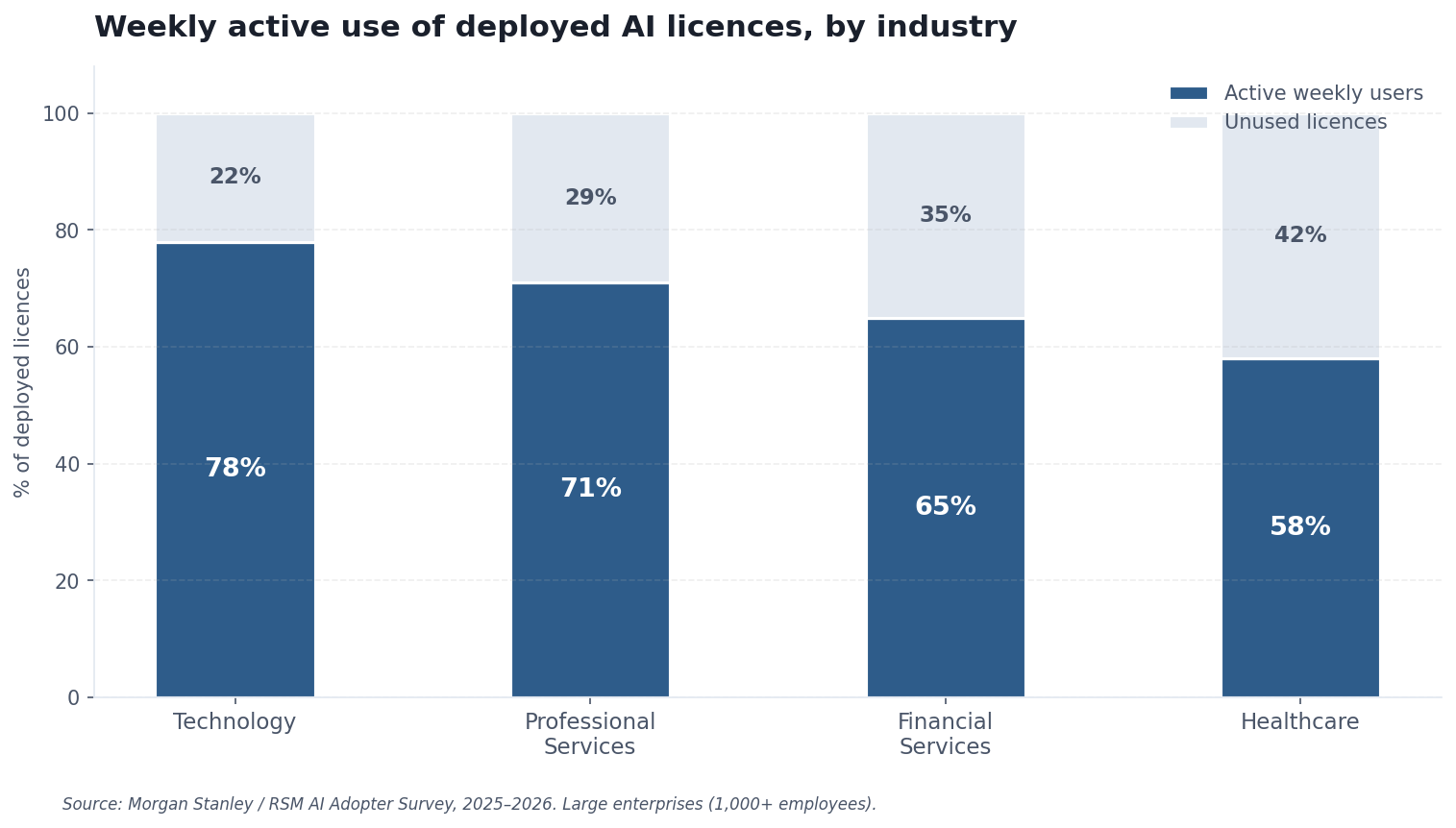
Technology firms reach nearly 80% active weekly use. Professional services sit in the seventies. Financial services land in the mid-sixties. Healthcare, weighed down by regulatory friction, legacy workflow complexity, and cautious clinical adoption, comes in under 60%. For a regulated enterprise with 20,000 Copilot seats, the activation gap alone can account for three to four million dollars a year of pure shelfware.
Microsoft’s own disclosures tell a similar story at the macro level. As of the end of 2025, Microsoft reported 16.1 million paid Copilot seats against roughly 12 million daily active users — impressive absolute growth, but a reminder that even with the largest distribution advantage in enterprise software, the gap between provisioned and actively used is material.
⚠️ Watch Out: Roughly half the AI spend produces roughly zero of the AI activity.
Why licence deployment is not adoption
Four patterns explain almost every activation gap I see inside large enterprises:
-
The tool was procured, not chosen. A large share of enterprise Copilot deployments happened because Microsoft made the commercial case easy to the CIO, not because employees asked for it. When users have a real choice between AI tools, a recent enterprise survey found that three-quarters of them pick ChatGPT as their primary tool; Copilot receives around 18%. Employees route to what works, not what is licensed.
-
The licence was deployed without a workflow behind it. A Copilot seat is not a use case. A seat is permission to access a tool. Without an explicit workflow the tool is meant to change — draft customer emails in Outlook, summarise meetings in Teams, analyse variances in Excel — employees have no anchor. They log in once, don’t know what to do, and stop coming back.
-
Managers were skipped. The front-line manager is the layer that turns individual tool access into team behaviour. When the manager doesn’t use the tool, can’t describe what good use looks like, and doesn’t reward AI-assisted output, the team drifts back to whatever worked before. BCG’s 2025 workforce survey found that only around a quarter of frontline workers say their leaders give them sufficient guidance on AI. That is an adoption killer at scale.
-
Nobody owns activation. Procurement owned the contract. IT owned the deployment. L&D owned the training. Nobody owned the outcome. When activation is everybody’s responsibility, it is nobody’s, and the licence quietly idles.
The activation funnel
It helps to visualise what actually happens after an AI contract is signed:
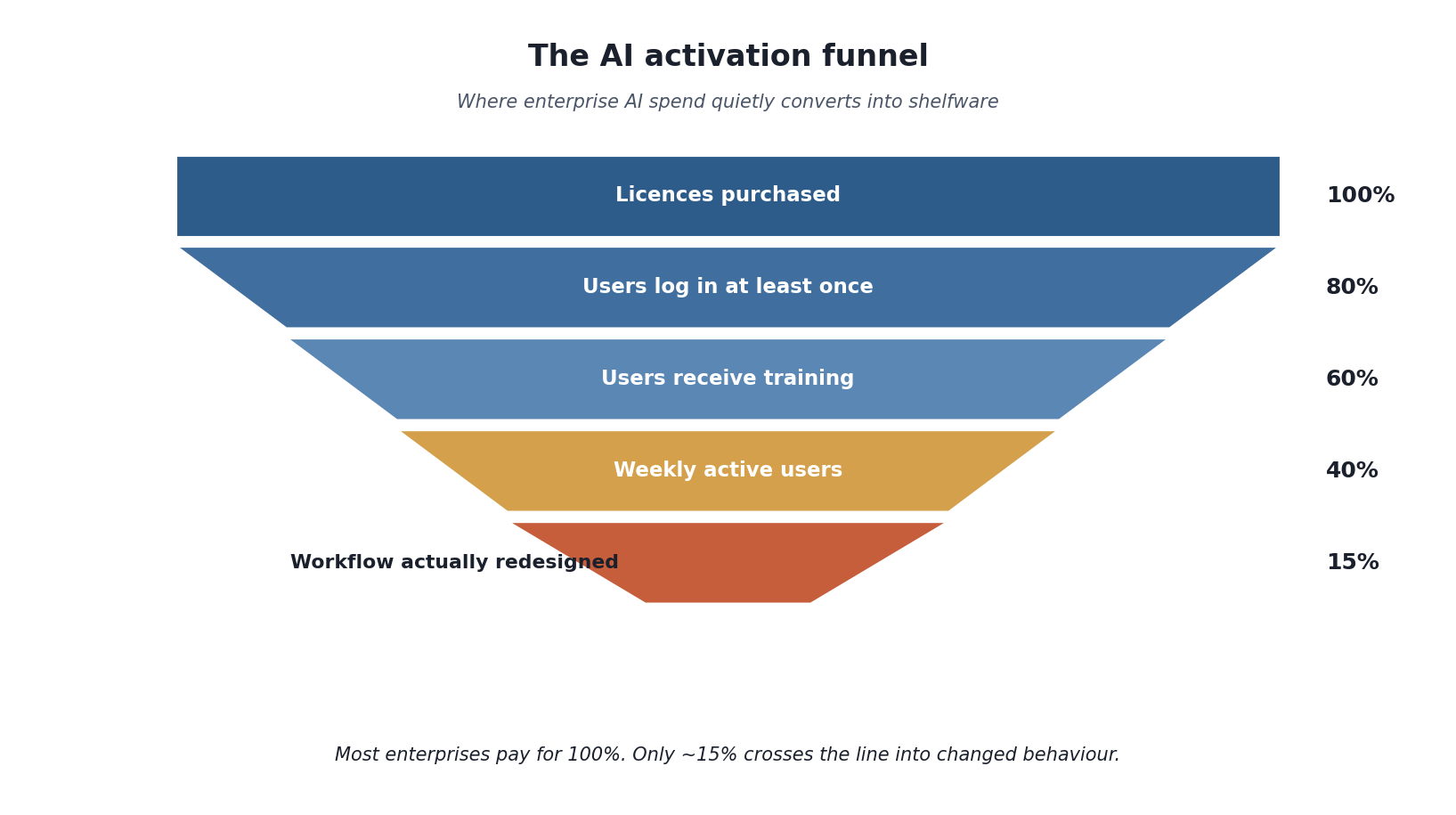
Of 100 licences purchased, perhaps 80 users log in at least once. Around 60 receive any form of training. Roughly 40 become weekly active users. And only about 15 ever see a workflow redesigned around the tool — which is the only point in the funnel where measurable business value actually lands. The rest is activity without impact.
The striking thing about this funnel is that most of the leakage is fixable. Each stage has a known fix. Almost no enterprise applies them systematically, because no single executive owns the whole chain.
A playbook for turning seats into behaviour
Four moves consistently separate enterprises that convert AI spend into business outcomes from those that don’t:
💡 Key Insight: The striking thing about this funnel is that most of the leakage is fixable.
-
Appoint a single activation owner. One executive, named, accountable, with the authority to pull on IT, L&D, line management, and procurement. Without a single throat to choke, the funnel leaks at every stage. This is not a governance committee — it is one name on one slide.
-
Tie every licence cohort to a workflow. Before any seats are deployed to a team, define the two or three specific workflows the tool is meant to change. Draft first-response customer emails. Summarise weekly sales calls. Pre-populate month-end variance commentary. No workflow, no seats. This one rule eliminates the largest category of shelfware at source.
-
Train managers before teams. For every hundred employees trained on an AI tool, the manager has to be trained first — and expected to coach, model, and reward the tool’s use in weekly cadence. Teams drift toward what their managers recognise. Until managers recognise AI-assisted output, adoption will always lag.
-
Put activation metrics on the executive dashboard. Weekly active users as a percentage of deployed seats. Workflows redesigned per quarter. Business KPI shifts attributable to the tool. If these numbers aren’t reported at the executive table, the activation problem will never be fixed — because no one in the room will feel the cost of it.
The leader’s 30-day move
A concrete sequence before the next renewal cycle:
-
Week 1. Pull the utilisation data for every AI licence in the enterprise. Active weekly users as a percentage of deployed seats, by tool, by function. Most CIOs can produce this in 48 hours. Most CFOs have never seen it.
-
Week 2. Identify the three functions with the largest gap between seats deployed and active use. These are your priority interventions. Kill or reclaim licences where activation has been under 30% for more than a quarter.
-
Week 3. For the prioritised functions, define two or three specific workflows the tool will change. Assign a workflow owner and set a behaviour baseline.
-
Week 4. Put activation metrics on the next executive review. Make the CIO, CFO, and functional leaders accountable to the same number.
Enterprises that apply this discipline consistently report activation gains of 15–25 percentage points within two quarters — which on a seven-figure licence spend is not a rounding error.
✅ Leadership Action: The question on your next AI renewal is not whether to buy more licences.
The consultant’s takeaway
Gartner is now predicting that by 2028, over half of enterprises will stop paying for assistive AI tools altogether and move to outcome-based, workflow-embedded AI — paying for results rather than seats. That shift is coming. The enterprises that arrive at that transition with a disciplined view of which licences drive behaviour, and which don’t, will be the ones best positioned to restructure their spend intelligently.
The question on your next AI renewal is not whether to buy more licences. It is whether the licences you already own are actually doing any work. The answer, for most enterprises, is a very expensive “no.” Fixing it doesn’t require new technology. It requires accountability, workflow design, and the willingness to measure something most leaders have so far preferred not to look at.