The AI-Native Competitor Is Already In Your Market
Three things happened in late 2025 that should have changed every incumbent boardroom conversation about AI.
In October, Sierra — a customer support AI company founded in 2023 — crossed $100 million in annual recurring revenue. By January 2026 it had passed $150 million, with a $10 billion valuation. Its customers include Weight Watchers, SiriusXM, Sonos, ADT, and Redfin. It charges roughly $1.50 per resolved customer interaction — about 10% of the human equivalent.
In the same window, Decagon, an AI-native customer support competitor founded in the same year, tripled its valuation in six months — to $4.5 billion in January 2026 — after adding more than 100 enterprise customers including Deutsche Telekom, Avis Budget, Block, and Chime. Chime reports a 60%+ reduction in its contact centre costs. 53% of Decagon’s customers replaced an existing IVR, ticketing, or CRM-based agent system to move to it.
In legal, Harvey reached an $11 billion valuation in March 2026 and is now embedded in roughly half of the Am Law 100. In Europe, Stockholm-based Legora has raised over €500 million in a single Series D round and is taking direct aim at LexisNexis, Thomson Reuters, and Harvey itself.
The pattern is not isolated. Menlo Ventures’ 2025 State of Generative AI in the Enterprise found that at the AI application layer, AI-native startups have moved from 36% market share in 2024 to 63% in 2025 — capturing nearly $2 in revenue for every $1 earned by incumbents. That is not the early-warning data. That is the result.
📊 The Numbers: AI-native startups captured 36% market share in 2024. By 2025, they captured 63% — nearly $2 in revenue for every $1 earned by incumbents.
The previous posts in this series have been about how to run AI well inside the enterprise — selection, ROI, scaling, training, governance, activation. This post pivots outward. It addresses the question that most C-suite leaders are starting to ask in early 2026 but few are answering rigorously: are we the disruptor or the disrupted in our category, and how would we know before the P&L tells us?
The line has already been crossed — but unevenly
The most important pattern in the 2025–2026 data is not that AI-native startups are winning. It is that they are winning very unevenly across enterprise functions.
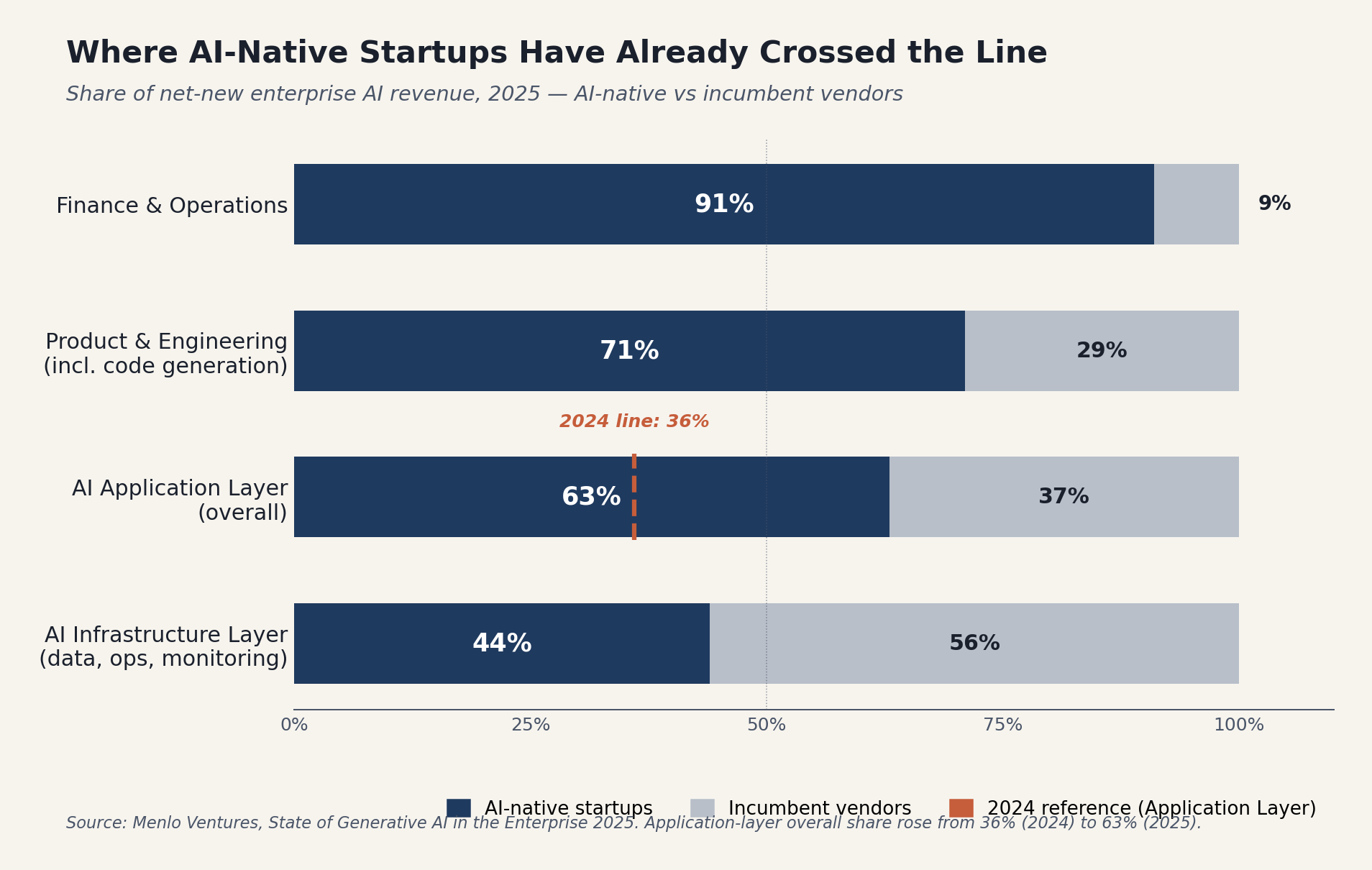
The map above, drawn from Menlo Ventures’ enterprise spend data, is the single most useful diagnostic for any incumbent leadership team in 2026. It says three things.
First, in finance and operations, AI-native startups already hold 91% of net new spend. This is the function where regulated incumbents like Intuit move slowest — accuracy demands, audit requirements, and integration complexity slow their AI roadmap, and AI-first ERPs like Rillet, Campfire, and Numeric have walked into the gap. Total dollars are still small, but the trajectory is decisive.
Second, in product and engineering — code generation in particular — startups hold 71% share. Cursor (Anysphere) is the canonical case: GitHub Copilot was the first mover with every structural advantage, and Cursor still captured significant share by shipping repo-level context, multi-file editing, and natural-language commands faster than Microsoft could. The lesson generalises. In categories where the rate of feature delivery is the moat, AI-native companies will win.
Third, incumbents still hold the line in infrastructure, IT, and data platforms. Databricks, Snowflake, MongoDB, and Datadog each saw AI-driven re-acceleration in 2025. Even AI-native application builders are choosing existing infrastructure platforms to manage their data and orchestrate workflows. Where reliability, integration depth, and existing system dependencies matter more than raw iteration speed, incumbents are not just defending — they are growing.
This is the strategic picture every leader needs on a single page: where you sit on this map determines almost everything about how you should respond.
What “AI-native” actually means — and why it matters
The term is now used loosely enough to be almost meaningless. The distinction that matters is structural, not stylistic.
An AI-enhanced enterprise uses AI internally — to draft faster, summarise faster, code faster. The product itself, however, still assumes a human user, and the workflows still reflect pre-AI design assumptions. This is the model most incumbents are running.
An AI-native competitor builds the product so that AI is the primary user, the primary execution layer, or both. Sierra’s agents don’t just answer questions; they take actions inside customer systems — issuing refunds, updating CRMs, processing returns. Harvey’s product is not a chatbot bolted onto Westlaw; it is a system that produces work product the lawyer reviews. Decagon’s Agent Operating Procedures translate plain-English service rules into code-level agent behaviour without engineering intermediation.
This structural difference compounds. AI-native architectures avoid the agent overlay tax — the cost of retrofitting AI onto workflows designed for humans. They charge per outcome rather than per seat, which aligns vendor incentives with customer results in ways legacy SaaS contracts cannot. And critically, they accumulate workflow data that incumbents never see.
⚠️ Watch Out: Outcome-based pricing aligns vendor incentives with customer results in ways legacy SaaS contracts cannot. If you’re still selling by the seat, you’re at a structural disadvantage.
Sapphire Ventures’ 2026 outlook captures the implication bluntly: at least 50 AI-native businesses are expected to reach $250 million in ARR by end of 2026, with several crossing the billion-dollar mark. By their count, more than 60 AI-native products had already passed $100 million ARR by end of 2025. This is not a wave forming. It is a wave that has already broken.
The European picture matters more than US-centric coverage suggests
Most coverage of AI-native disruption is written from San Francisco. For European leaders, the picture is genuinely different — and increasingly material.
European venture funding hit $17.6 billion in Q1 2026, up nearly 30% year-over-year, with the four largest rounds all going to AI-native companies. France’s Mistral has raised over €2 billion. Stockholm’s Legora is now Harvey’s most credible global challenger. UK-based Wayve is at an $8.6 billion valuation in autonomous driving; Synthesia has crossed $100 million ARR in generative video. Black Forest Labs (image), Lovable (development), and Nscale (infrastructure) round out a credible European AI-native cohort.
Three things make the European picture distinctive for an incumbent leader. First, the EU AI Act enters live enforcement on 2 August 2026, which changes the compliance burden for general-purpose model providers and creates a competitive variable that US-only AI strategy decks largely ignore. Second, sovereignty has become a real procurement criterion in DAX, CAC, and FTSE accounts — European incumbents now have an asymmetric advantage in regulated and public-sector deals if they choose to use it. Third, the European AI-native cohort is concentrated in vertical applications and infrastructure rather than horizontal foundation models, which means the threat profile for a European incumbent is more about being out-iterated in your category than about a global platform shift.
The “European AI is dead” narrative has aged badly. The more useful question is whether your specific market is being entered by a European AI-native player, a US-based one, or both.
Why the incumbent playbook fails here
Most incumbent responses to AI-native competition are versions of the same playbook: appoint a Chief AI Officer, launch an AI feature in the existing product, sign a partnership with a foundation model provider, announce it on the earnings call. This playbook has worked before. It is not working now, and the reasons are structural.
Iteration speed. AI-native startups release weekly. Most enterprise software releases quarterly. In categories where the rate of capability improvement is the buying criterion — code generation, customer support, legal research — quarterly is already losing.
Architectural debt. A retrofitted AI feature inside a legacy product carries the cost of every workflow, integration, and UI assumption built before the feature existed. An AI-native competitor built on a clean schema does not. This is why incumbents routinely ship “the same” feature months later and lose deals anyway.
Pricing model. Most incumbents sell AI by the seat. AI-native vendors increasingly sell by outcome — per resolution, per submission, per generated artefact. When the buyer is a CFO under pressure to show AI ROI, outcome pricing wins almost every time. Gartner now expects more than half of enterprises to move to outcome-based AI contracts by 2028.
Distribution data. SaaS incumbents won the last decade by owning systems of record. AI-native agents own systems of action — the logic of how the business actually runs. As ServiceNow’s January 2026 partnership with OpenAI quietly acknowledged, the next moat is not the data the customer puts into the system; it is the workflows the system executes on the customer’s behalf.
The incumbent response that works is not “add AI to our product.” It is to decide, deliberately and quickly, which of three strategies fits your situation.
The three responses — and the conditions under which each works
Across the cases that have played out in the last 24 months, three credible strategic responses have emerged for incumbents whose category is being entered.
Defend. Make the integration and switching costs of leaving you so high that even a faster, cheaper AI-native competitor cannot dislodge customers. This works when you own the system of record, when your data is genuinely proprietary, and when your customers are large and risk-averse. Salesforce and Microsoft are running versions of this play. It is expensive and slow, and it works only if you can hold the line for the three to five years it takes for AI-native pricing pressure to compress.
Partner. Bring an AI-native capability inside your distribution rather than trying to build it. ServiceNow + OpenAI is the archetype. The bet is that the AI-native company values your distribution more than its own brand, and that you can integrate fast enough not to lose your customers in the meantime. This works in categories where the AI-native cohort is fragmented and capital-intensive enough that distribution still matters.
Rebuild. Take the most exposed product line, isolate it, and rebuild it AI-natively from a clean schema, with separate teams, separate metrics, and explicit permission to cannibalise the legacy product. This is the hardest move organisationally and the only one that works if your category is fundamentally being re-architected. Bessemer and others now expect a wave of incumbent M&A through 2026 because most large enterprises will conclude they cannot rebuild fast enough internally — which makes acquisition the rebuild path.
The wrong move in 2026 is not picking the wrong response. It is failing to choose at all and running a generic AI strategy that is none of the three.
💡 Key Insight: The wrong move is not picking the wrong response. It is failing to choose, and running a generic AI strategy that is none of the three.
The leader’s 30-day diagnostic
Five questions, applied honestly to your category, will tell you which response fits.
- Has an AI-native competitor entered your market? Search by function, not by company name. If you cannot list the three best-funded AI-native players targeting your segment by name, your competitive intelligence is already behind.
- Where do you sit on the function-by-function map? Finance, ops, customer support, code, legal, marketing — these are exposed. IT, data science, infrastructure — less so. Your position determines urgency.
- Are you selling by seat while competitors are selling by outcome? If so, your pricing model is now a strategic liability. The CFO conversation about AI ROI is being won by whoever can quote a per-outcome number.
- Does your product require legacy workflows to function? If a competitor’s customer can switch without re-architecting their internal processes, your switching-cost moat is thinner than you think.
- Who in your organisation is accountable for naming the response? If “compete with AI-native players” is in three executives’ OKRs and no one’s mandate, you do not yet have a response. You have a meeting.
If your answers point to exposure, the next step is not another AI strategy review. It is to commit, this quarter, to one of the three responses — defend, partner, or rebuild — and fund it accordingly.
✅ Leadership Action: If your answers point to exposure, commit this quarter to one response — defend, partner, or rebuild — and fund it accordingly. Ambiguity is the fastest path to disruption.
The consultant’s takeaway
The most dangerous position for an incumbent in 2026 is not being disrupted. It is being disrupted slowly enough not to notice. Sierra’s growth from $26 million to $150 million ARR in twelve months is what fast disruption looks like; the equivalent in your category may be quieter, but the structural advantages are the same.
The leaders who navigate this well in the next eighteen months will not be the ones who ran the most AI pilots, hired the most data scientists, or signed the most foundation-model partnerships. They will be the ones who looked honestly at the function-by-function map, identified where their category sat on it, and made an explicit choice — defend, partner, or rebuild — before the choice was made for them.
The question is no longer whether AI-native competition is coming. It is whether your organisation is structured to recognise it before the next earnings call.