AI Is Eating Your Org Chart: What Leaders Get Wrong About Restructuring Around AI
Every week in 2026 brings another announcement. PayPal will cut a fifth of its workforce. Cloudflare eliminates 1,100 roles and calls it an “agentic AI-first operating model.” Amazon removes tens of thousands of corporate jobs to flatten layers. The headlines say AI is replacing people. The reality is more uncomfortable: most of these companies are cutting the org chart before they have redesigned the work, and before they have built the governance to run what is left.
The meeting is happening in boardrooms across Europe right now. A consulting deck lands on the table showing competitors running leaner. The CFO points to the headcount line. The CEO, who according to WRITER’s 2026 enterprise survey has a 73% chance of reporting stress or anxiety about the company’s AI strategy, asks the obvious question: if AI makes everyone more productive, why are we still carrying this structure? Within a quarter, a restructuring is announced, framed as “becoming AI-native.” Twelve months later, the same broken processes are running with fewer people to catch the errors.
This is the org-chart trap, and in 2026 it is the most expensive mistake in enterprise AI. The previous posts in this series dealt with selecting use cases, capturing ROI, scaling agents, and activating the licences you already bought. This one deals with what happens when leaders point AI at the organisation itself. The pattern is the same failure that kills AI pilots, only now it is being applied to people’s jobs and the company’s risk surface at the same time.
📊 The Numbers: 69% of enterprises are planning layoffs because of AI. Only 23% have a documented AI governance framework, and roughly 21% have redesigned a workflow end-to-end. The action is running three times ahead of the foundations.
The restructuring wave is real, and it is not the cycle you remember
The cuts are not hypothetical. PayPal announced in May 2026 a workforce reduction of roughly 20%, around 4,760 roles over two to three years, with the CEO framing it around removing duplication and layers and accelerating AI adoption. Cloudflare cut about 1,100 jobs, nearly 20% of its people, the same week it beat revenue expectations, explicitly to rebuild around an agentic AI-first operating model. Meta began cutting around 8,000 roles and reorganised thousands of engineers into AI-focused “pods.” Accenture is running an AI-focused restructuring affecting at least 11,000 people. Tata Consultancy Services is removing roughly 12,000 roles, concentrated in middle and senior management. Amazon has confirmed tens of thousands of corporate cuts justified explicitly by the need for fewer layers and more ownership.
The European list is shorter but more strategically loaded. Commerzbank is cutting thousands of roles while committing a multi-year AI investment programme, partly as a case for standalone independence against a takeover bid. Porsche plans to reduce positions in Germany through to the end of the decade. SAP has moved from one-off cuts to what its leadership describes as a continuous repositioning of roles around Business AI.
Here is what makes this different from 2022 and 2023. Those cuts were openly described as correcting pandemic over-hiring. The 2026 cuts are described as permanent structural decisions about which functions still require humans at all. That distinction matters, because a correction can be reversed when conditions improve. A capability-driven restructuring is a bet that the work itself has changed. If that bet is placed before the work has actually been redesigned, it is not a strategy. It is a hope with a severance cost attached.
Why most of this restructuring will fail its own thesis
The evidence on sequencing is unusually clear, and it points the opposite way from how most companies are acting.
McKinsey’s State of AI, published in November 2025, found that while 88% of organisations now use AI somewhere, only about 6% are genuine high performers capturing material EBIT impact. The single behaviour that separates them is not how much they spend or how many people they cut. It is that they have fundamentally redesigned workflows. High performers are nearly three times as likely to have done this end-to-end work. The redesign, not the headcount reduction, is what produces the value.
Set that against what happens when companies move in the wrong order. S&P Global Market Intelligence found that the share of organisations abandoning the majority of their AI initiatives before they reached production jumped from 17% to 42% in a single year. Gartner expects 60% of AI projects unsupported by AI-ready data to be scrapped through 2026. Cutting the organisation faster does nothing to fix the data fragmentation, unclear decision rights, and un-redesigned processes that caused those pilots to fail. It simply removes the people who were absorbing the friction those failures created.
The chart below is the whole argument on one page. It contrasts what enterprises are doing with what they have actually built underneath.
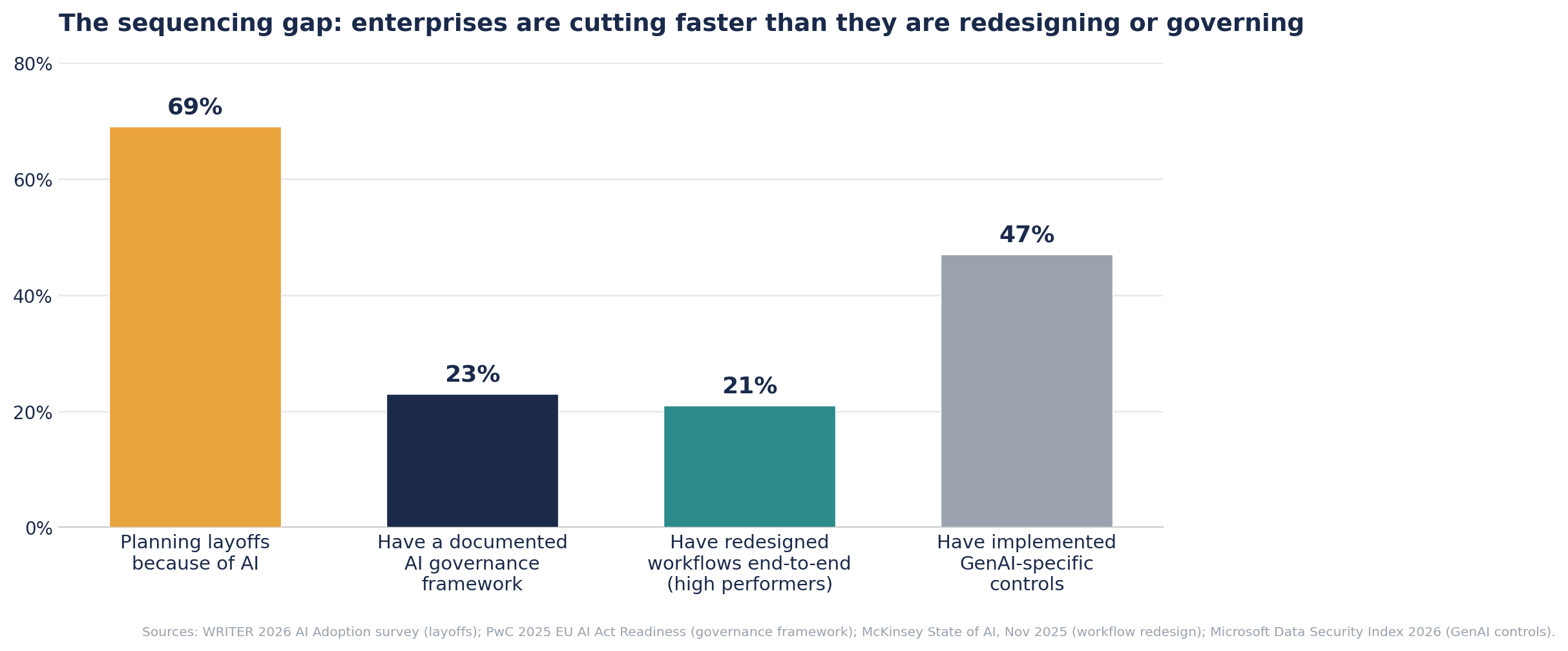
Sixty-nine percent of enterprises are planning layoffs because of AI. Twenty-three percent have a documented AI governance framework. Roughly a fifth have redesigned a workflow end-to-end. Fewer than half have controls specific to generative AI. The action is running three times ahead of the foundations. That gap is the failure, and it is entirely self-inflicted.
Four things that break when you cut before you redesign
Across the restructurings playing out now, the same four failures appear repeatedly.
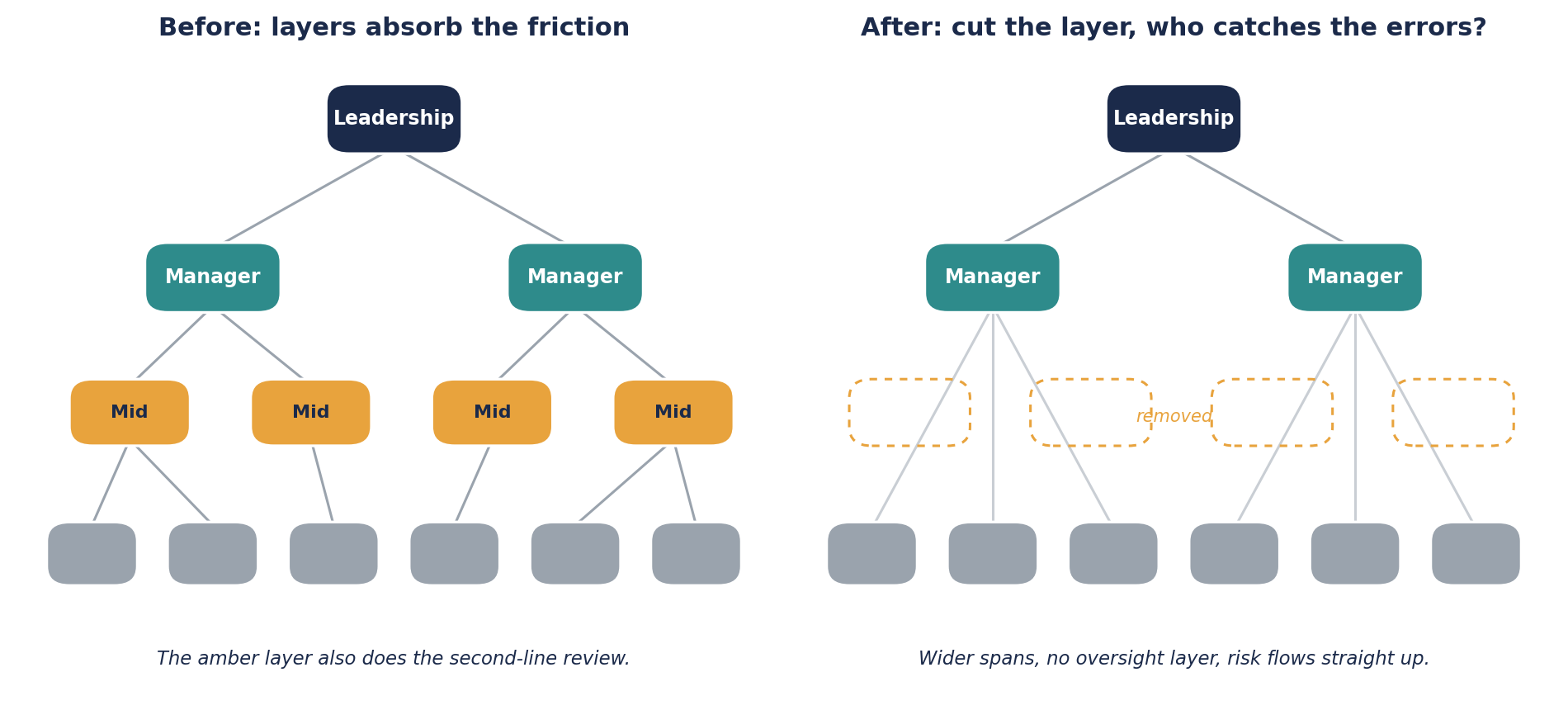
1. You delayer the people who were doing the oversight. The middle-management layer everyone is racing to cut was doing three jobs at once: coordinating work, developing people, and acting as the last human check on what flowed up and down the chain. The coordination is genuinely automatable. The last-human-check is the operational definition of human-in-the-loop. Gartner has predicted that through 2026, a fifth of organisations will use AI to eliminate more than half of current middle-management positions. When you remove that layer without putting the oversight somewhere else, you have not become efficient. You have removed your second line of defence.
2. Accountability becomes diffuse exactly as the risk concentrates. At the moment companies are thinning the human layer, the machine layer is acting more autonomously. Okta’s 2026 research found that 88% of organisations report suspected or confirmed AI agent security incidents, while only about a fifth treat those agents as identity-bearing entities they actually govern. Microsoft’s 2026 Data Security Index reports generative AI is now implicated in around a third of data security incidents, yet under half of organisations have GenAI-specific controls. IBM’s 2025 breach research put a number on the consequence: shadow AI adds roughly 670,000 dollars to the average breach cost. Cut the humans who owned exception handling, and that residual risk does not disappear. It lands on the executive who signed the restructuring.
3. The same broken process now runs faster with fewer people to fix it. If the workflow underneath was never redesigned, AI does not eliminate the work. It accelerates the parts that were already fast and leaves the bottlenecks untouched, now with a thinner team. This is the productivity paradox from earlier in this series, scaled up to the level of the whole organisation. A leaner org running an un-redesigned process is not a transformation. It is the old company with more stress and less slack.
4. You restructure ahead of a regulator who is about to ask who is in charge. For European leaders this is not a soft risk. The EU AI Act’s high-risk obligations become enforceable on 2 August 2026. From that date, deployers of high-risk AI systems must have named responsible persons for risk monitoring and incident handling, a quality-management system, and a human-oversight architecture built into the design, with penalties scaling to 15 million euros or 3% of global turnover. A company that has just delayered the very people who would have owned that oversight, without naming who now does, is walking into both operational and regulatory exposure at once.
⚠️ Watch Out: The middle layer you are cutting was doing the second-line review no AI agent has yet earned the right to do alone. Remove it without relocating the oversight, and the residual risk lands directly on the executive who signed the restructuring.
What the companies getting this right do differently
The organisations capturing real value are not the ones cutting deepest. They are the ones sequencing governance and operating model before headcount. Four moves separate them.
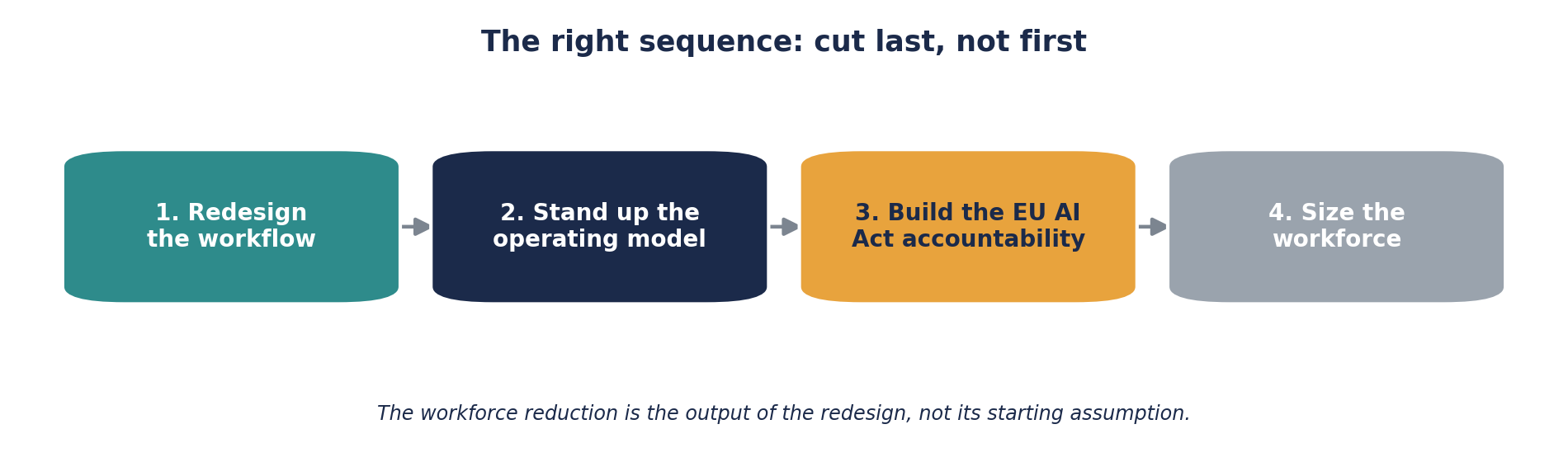
- Stand up the operating model before you touch the structure. IBM’s 2025 research on Chief AI Officers found that organisations running hub-and-spoke or centralised AI operating models see around 36% higher AI ROI than those running decentralised, every-team-for-itself models. The shape of how AI is governed and delivered is itself a driver of return. Decide that shape, with shared standards and architecture at the centre and execution in the business units, before you start removing layers from the chart.
- Give one executive real authority, not a compliance title. More than half of CAIOs now report directly to the CEO or board. But the role fails in a predictable way, especially in Europe, when it becomes a highly paid compliance anchor: a figurehead with no budget, no cross-functional authority, and KPIs measured in documents produced rather than outcomes moved. Appoint someone with a pilot budget, authority across at least three business units, and a direct line to the top. Measure them on production deployments and EBIT, not on policy pages.
- Build the EU AI Act spine into the org design, not alongside it. Inventory every AI system, classify each against the high-risk criteria, assign a named risk owner to each high-risk system, and adopt a recognised management-system standard such as ISO 42001 as the backbone. With only around a quarter of European mid-market firms holding a documented governance framework today, doing this early is not just compliance. It is a competitive position: you will be auditable when your competitors are scrambling.
- Redesign the workflow first, then size the workforce to it. This is the move that mirrors the high performers in the McKinsey data. Pick three to five value streams. Redesign them end-to-end with AI as the default path, not a feature bolted onto the old process. Measure the new cycle time. Then, and only then, size the team to the redesigned operation. The workforce reduction becomes the output of the redesign, not its starting assumption.
💡 Key Insight: The companies that look smart in eighteen months will not be the ones with the deepest cuts. They will be the ones that redesigned the work, governed it, and then sized the workforce to the operation they had actually rebuilt. The order is the strategy.
The leader’s 30-day move
A concrete sequence before the next restructuring decision is signed.
- Week 1. Before approving any AI-driven restructuring above a token threshold, demand a one-page answer per affected function to four questions: which workflows have we actually redesigned, who now owns AI output review and incident response, what is the EU AI Act risk classification of the systems replacing these roles, and what oversight capacity are we adding to absorb what the cut managers were doing. If a function cannot answer all four, it is not ready to be cut.
- Week 2. Decide the AI operating model. Centralised or hub-and-spoke, with standards and architecture at the centre and delivery in the business units. Name the single executive accountable for it, with budget and cross-unit authority. This is one name on one slide, not a steering committee.
- Week 3. Run the EU AI Act inventory. Every AI system classified, every high-risk system assigned a named human owner, the human-oversight design documented. Treat 2 August 2026 as a hard date, because for high-risk systems it is.
- Week 4. Select the three to five workflows you will redesign end-to-end this quarter. Set a cycle-time baseline now. Make clear to the organisation that the structure will follow the redesign, not precede it.
✅ Leadership Action: Put a rule on the next restructuring proposal: no function gets cut until it can name the redesigned workflow, the human owner of AI oversight, and the EU AI Act classification of what is replacing the roles. If it cannot, it is a pilot, not a production decision.
Companies that sequence in this order do not cut less in the end. They cut more precisely, they keep the oversight they need, and they do not spend the following year discovering what the delayered managers were quietly holding together.
The consultant’s takeaway
Most leaders are running the AI restructuring playbook in the wrong order. They cut the org chart first, then discover that the workflows underneath were never redesigned, that the governance the regulator and their own board now expect does not exist, and that the management layer they removed was performing the second-line oversight no AI agent has yet earned the right to do alone.
The companies that will look smart in eighteen months will not be the ones with the deepest cuts. They will be the ones that redesigned the work, stood up an operating model with someone genuinely accountable for it, built EU AI Act compliance into the structure before August 2026, and then sized the workforce to the operation they had actually rebuilt. The order is the strategy.
AI is going to reshape the org chart. That is not in question. The only question is whether you redesign the organisation deliberately, in the right sequence, or let a quarter of layoff announcements and a regulator’s deadline write the structure for you. In Frankfurt, that is no longer a matter of strategic taste. With the high-risk obligations live in August, it is a matter of getting the sequence right while there is still time to choose it.