The Verification Bottleneck: When Human Oversight Becomes the Thing That Cannot Scale
In two years, AI agents stopped being a demo and became a workforce. Stanford’s 2026 AI Index captured how fast. On OSWorld, a benchmark that asks agents to complete real computer tasks, success rates climbed from roughly 12% to 66.3%. On Terminal-Bench, which tests agents working in a command line, the jump was from 20% to 77.3%. The machines became good at doing the work, quickly.
The same report contains a second number that most boardrooms have not connected to the first. Documented AI incidents rose to 362 in 2025, up from 233 the year before, a roughly 55% increase recorded in the AI Incident Database. More capable agents are producing more output, and more of that output is going wrong in ways that reach the real world. Every one of those failures had to be caught by a human, or it was not caught at all.
This is the part of the agent story that the capability charts hide. The previous posts in this series dealt with selecting agentic use cases, scaling the architecture behind them, and redesigning the org chart around them. This one deals with the constraint that surfaces the moment those agents start working at volume. Not whether the agent can do the task, but whether your organisation can check that it did it correctly. That capacity is finite, it is expensive, and almost nobody has budgeted for it.
📊 The Numbers: Agent success on the OSWorld benchmark rose from roughly 12% to 66.3% in a single year (Stanford 2026 AI Index). Over the same period, documented AI incidents climbed to 362, up from 233. Capability scaled. The capacity to verify it did not.
Execution scaled. Verification did not.
For most of the last decade, the scarce resource in automation was the automation itself. Building the model and getting it to perform was the hard part, and the human in the loop was a rounding error on top. Agents invert this. The marginal cost of an agent doing one more task is approaching zero. The marginal cost of a qualified human verifying that task is not.
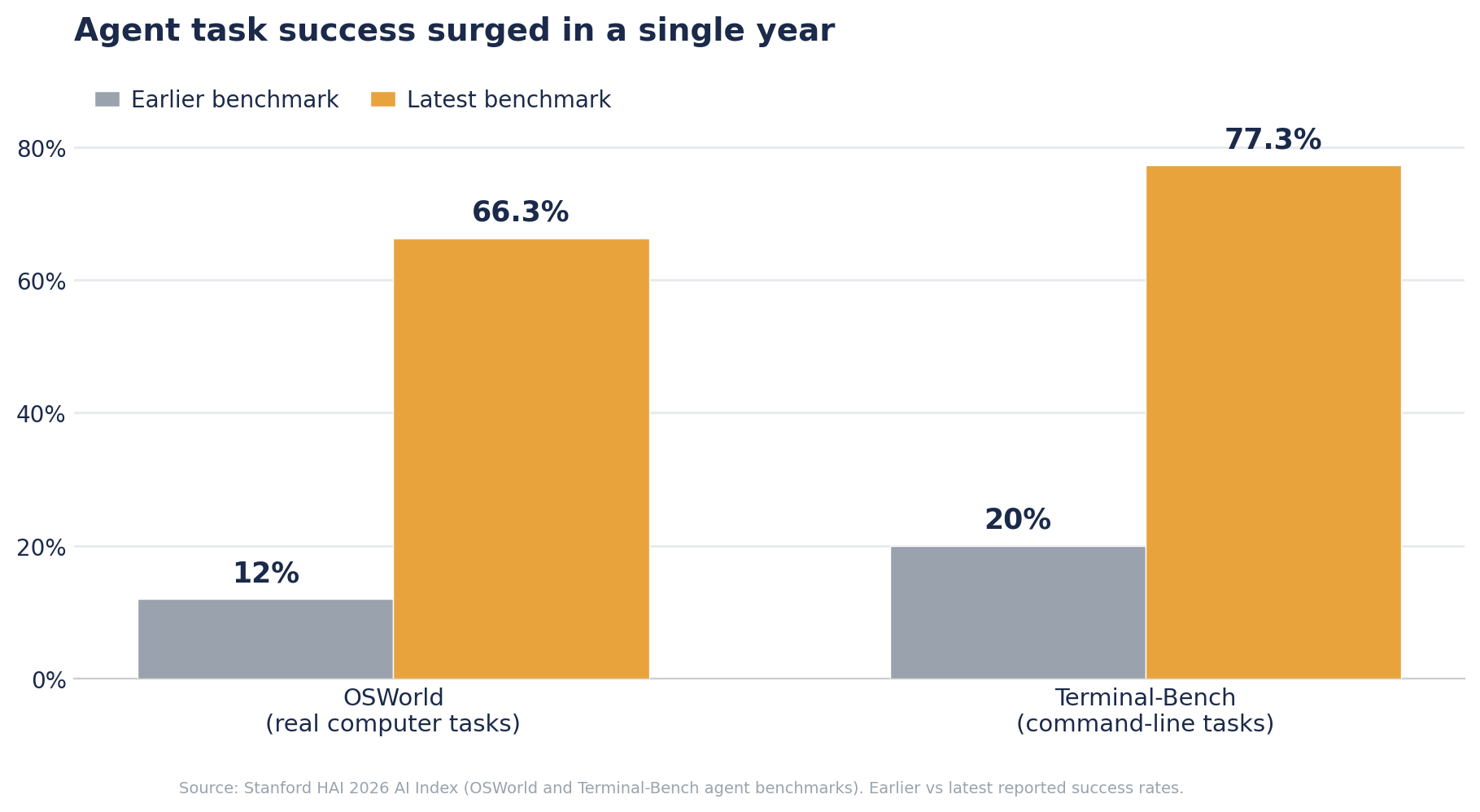
The chart shows the capability half of the story. It cannot show the other axis, because almost no enterprise measures it: how many agent outputs a single qualified reviewer can meaningfully check in a day. That number is roughly fixed by human attention, and it is the real ceiling on how much autonomy an organisation can safely run. When agent volume rises and review capacity stays flat, the gap does not disappear. It becomes a queue, a rubber stamp, or an unchecked failure. All three destroy the business case.
💡 Key Insight: The bottleneck in scaling agents is no longer model capability. It is the human capacity to verify what the models produce, and that capacity does not scale with compute.
The error rate nobody staffs for
An agent that succeeds 77% of the time is genuinely impressive and operationally dangerous at the same time. The 77% is what gets demonstrated to the board. The 23% is what determines whether the deployment makes or loses money, because every failure that escapes review carries a downstream cost almost always larger than the task itself. A mispriced quote, a wrong clinical summary, a payment sent to the wrong account.
An earlier post in this series called this the labour paradox, where human review burden quietly consumes the productivity AI appears to create. At agent scale it sharpens. The question is no longer how much time the agent saved, but how many of its outputs you can afford to check, and what happens to the ones you cannot. Most enterprises never answer either question. They count the speed of the 77% and discover the cost of the 23% later, in production.
⚠️ Watch Out: A high success rate is not a low oversight cost. The higher the volume an agent handles, the more absolute failures it produces, even as the percentage improves. Throughput without proportional review capacity is how a successful pilot becomes an expensive incident.
Span of control for agent bosses
Microsoft’s 2025 Work Trend Index, based on 31,000 workers across 31 countries, gave the emerging role a name. The agent boss, an employee who directs and supervises a team of agents rather than doing the work directly. The framing is useful, but it hides the hard question every operating model now has to answer. How many agents can one human actually supervise before oversight becomes fiction.
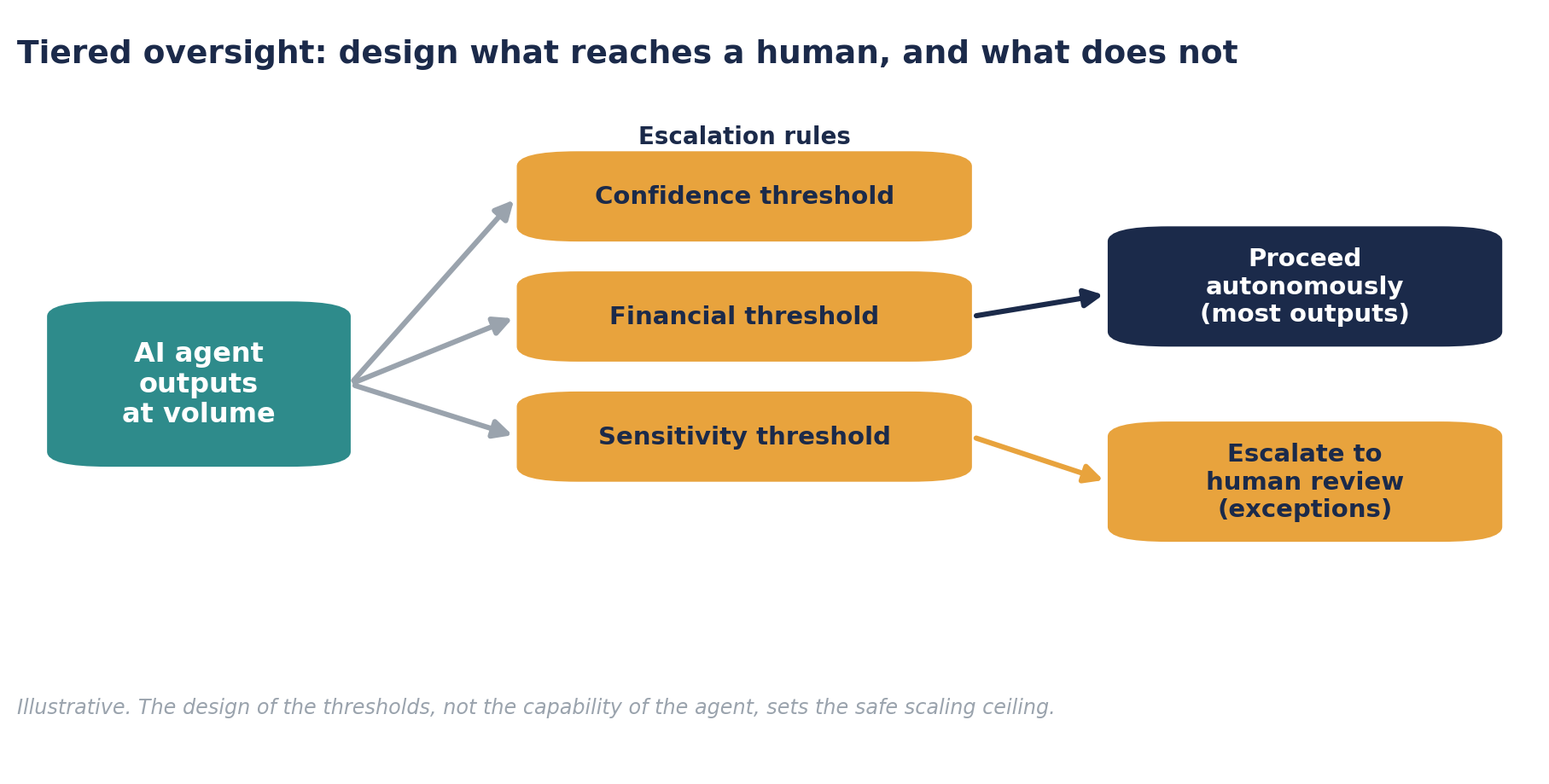
This is a span-of-control problem, and it is solved the way span of control has always been solved. By designing what reaches a human and what does not. The organisations getting this right are not reviewing every agent output, which is impossible, nor trusting every output, which is reckless. They are building tiered escalation, where the agent proceeds autonomously inside defined boundaries and routes to a human only when a confidence threshold, a financial threshold, or a sensitivity threshold is crossed. The design of those thresholds, not the capability of the agent, is what determines whether the system holds at scale.
The apprenticeship problem hiding underneath
There is a slower, more dangerous version of this constraint. The work AI agents now do well, drafting, summarising, first-pass analysis, is precisely the work junior employees used to do, and through which they became the senior reviewers who can verify an agent. Research from Stanford’s Digital Economy Lab found that employment for early-career workers in the most AI-exposed occupations has already declined measurably since generative AI became widely available, with the sharpest drops among the youngest cohorts.
The implication is uncomfortable. An organisation can automate away its junior roles, hit this year’s productivity target, and quietly dismantle the pipeline that produces the experienced people who catch an agent’s mistakes. The verifier is a senior role, and seniority is manufactured by doing junior work. Remove the junior work entirely and the supply of future verifiers stops, exactly as demand for verification rises. This is not a problem for next quarter. It is one leaders are deciding right now, without framing it as a decision.
In Europe, oversight is now an operating requirement
Everywhere in the world, verification capacity is an economic question. In Europe, it is also a legal one. The EU AI Act’s obligations for high-risk systems become enforceable on 2 August 2026, and Article 14 requires that high-risk AI systems be designed so they can be effectively overseen by humans, with named people able to understand the output, intervene, and stop the system. A Digital Omnibus package under discussion in 2026 may adjust some timelines, which is worth tracking, but the direction of travel is fixed.
Read alongside the capability data, this is not a compliance footnote. For any regulated, high-stakes workflow, the human oversight layer is no longer optional, and no longer something to bolt on after deployment. It is a design and staffing requirement that European enterprises have to build in from the start. Firms treating Article 14 as a box to tick after go-live are building exactly the rubber-stamp oversight the regulation exists to prevent. Firms treating it as an operating-model decision are sizing their verification capacity before they scale, which is what the economics demanded anyway.
✅ Leadership Action: For every high-risk agent deployment, define the human oversight design before approving the build. Who reviews what, under which thresholds, with what capacity, and how that scales as volume grows. In Europe, treat this as an Article 14 obligation, not an afterthought.
The leader’s 30-day move
A concrete sequence before the next agent deployment is signed off.
- Week 1. Measure the real ratio. For every agent already in production, calculate outputs generated per week against qualified human reviews actually performed. The gap between them is your current unmanaged risk. Most leaders have never seen this number.
- Week 2. Tier the escalation. For each agent, define what it may do autonomously and the confidence, financial, and sensitivity thresholds that route an output to a human. No agent runs without an explicit escalation design.
- Week 3. Name and size the oversight layer. Assign accountable human reviewers to each high-risk workflow and size that capacity against projected volume, not current volume. If the plan is to scale the agent tenfold, the review model has to survive that.
- Week 4. Protect the verifier pipeline. Before automating a junior role away, identify how your organisation will keep producing the experienced people who can supervise agents. If the answer is that it will not, reconsider the cut.
The consultant’s takeaway
The capability of AI agents is now the easy part. It improved faster last year than almost anyone forecast, and it will keep improving. What does not improve on the same curve is the human capacity to verify, govern, and recover from what those agents do, and that capacity is becoming the real constraint on how much value an enterprise can safely capture.
The leaders who navigate the next eighteen months well will not be the ones who deployed the most agents or automated the most aggressively. They will be the ones who treated verification as a first-class part of the operating model. Measured it, designed for it, staffed it, and protected the pipeline that produces the people who do it. In Frankfurt, with the EU AI Act’s high-risk obligations live from August, this is no longer only good practice. It is the difference between an agent programme that scales and one that becomes the incident the regulator asks about.
AI agents will do more and more of the work. The enduring advantage belongs to the organisations that can still tell, reliably and at scale, when they have got it wrong.