“We Trained 5,000 People on AI. Nothing Changed.”
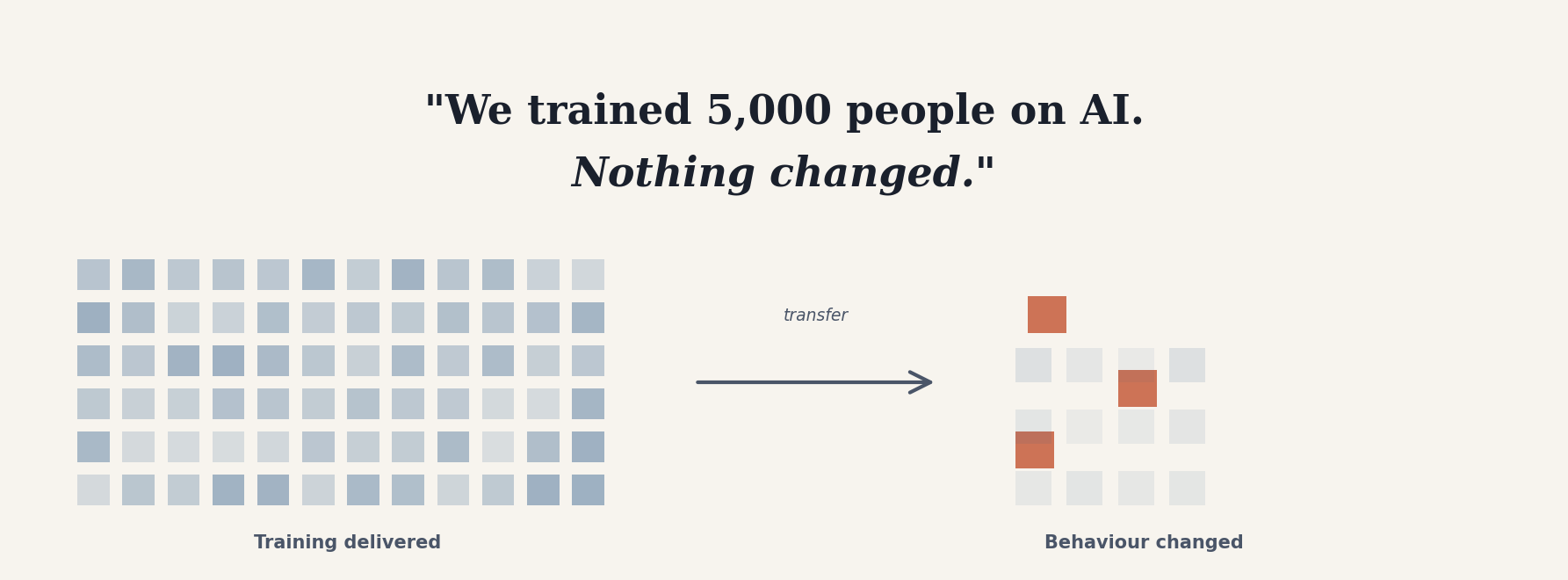
Why enterprise AI training programmes are failing — and what senior leaders need to do differently. A consultant’s guide.
Every Chief Human Resources Officer I speak with in 2026 has sat through a version of the same meeting. L&D presents the year’s AI training numbers: courses deployed, completions logged, certifications issued. The slide looks excellent. Then someone in the room — usually the CFO — asks the awkward question: what has actually changed in how people work?
In most enterprises, the honest answer is: very little.
This is one of the most expensive open secrets in enterprise AI. Deloitte’s 2026 State of AI in the Enterprise, based on 3,235 senior leaders across 24 countries, found that education was the number-one way companies adjusted their talent strategy for AI — ahead of role redesign, ahead of workflow change, ahead of hiring. ManpowerGroup’s 2026 Global Talent Barometer found that while regular AI use among workers rose 13% during 2025, confidence in the technology fell by 18%. People are using the tools more and trusting them less. That is not a training success story.
The starkest data point comes from Docebo’s 2026 AI Readiness Gap research: 85% of employees say they cannot apply the AI training they have received to their day-to-day jobs. This is not a marginal skills gap. It is the collapse of the training-to-behaviour bridge at enterprise scale.
The previous post in this series looked at why individual time savings from AI don’t add up to enterprise productivity. This post takes on the single biggest lever most leaders are pulling to fix that — training — and shows why the way it is being used is making the problem worse, not better.
📊 Leadership Signal: If completion rates are high but workflow behaviour is flat, the programme is optimising for reporting optics, not operating change.
The scale of the failure
Four numbers, all drawn from 2026 enterprise research, describe what is actually happening inside most AI training programmes:
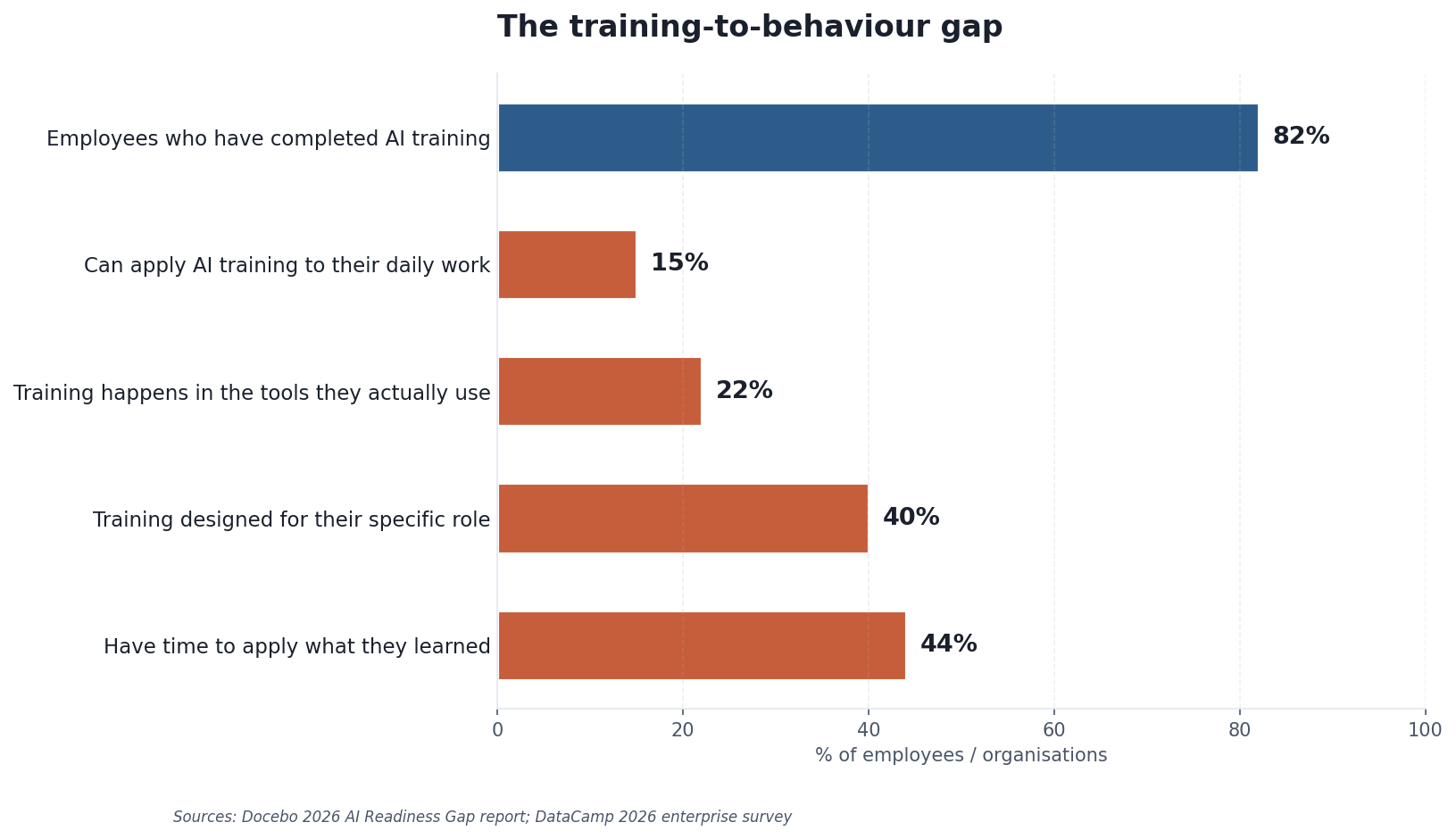
The first bar is the one every L&D team presents proudly. The other four are the bars nobody presents at all. Among employees who complete AI training, only around 15% can apply what they learned to their work. Only about 22% say their training happens in the tools they actually use day-to-day — Slack, Salesforce, the CRM, the ticketing system — rather than in a separate learning platform. Only 40% say the training was designed for people in roles like theirs. And more than half report they are so buried in pre-AI manual work that they don’t have time to learn the tools that are supposed to replace that work.
Taken together, these numbers explain why training spend keeps rising and measurable behaviour change keeps not showing up. The problem is not that employees can’t learn. The problem is that most enterprise AI training is designed in a way that makes transfer almost impossible.
⚠️ Watch Out: Training outside daily tools creates a predictable transfer gap. If learning is not embedded in where work happens, adoption will stall.
Four structural reasons most AI training fails
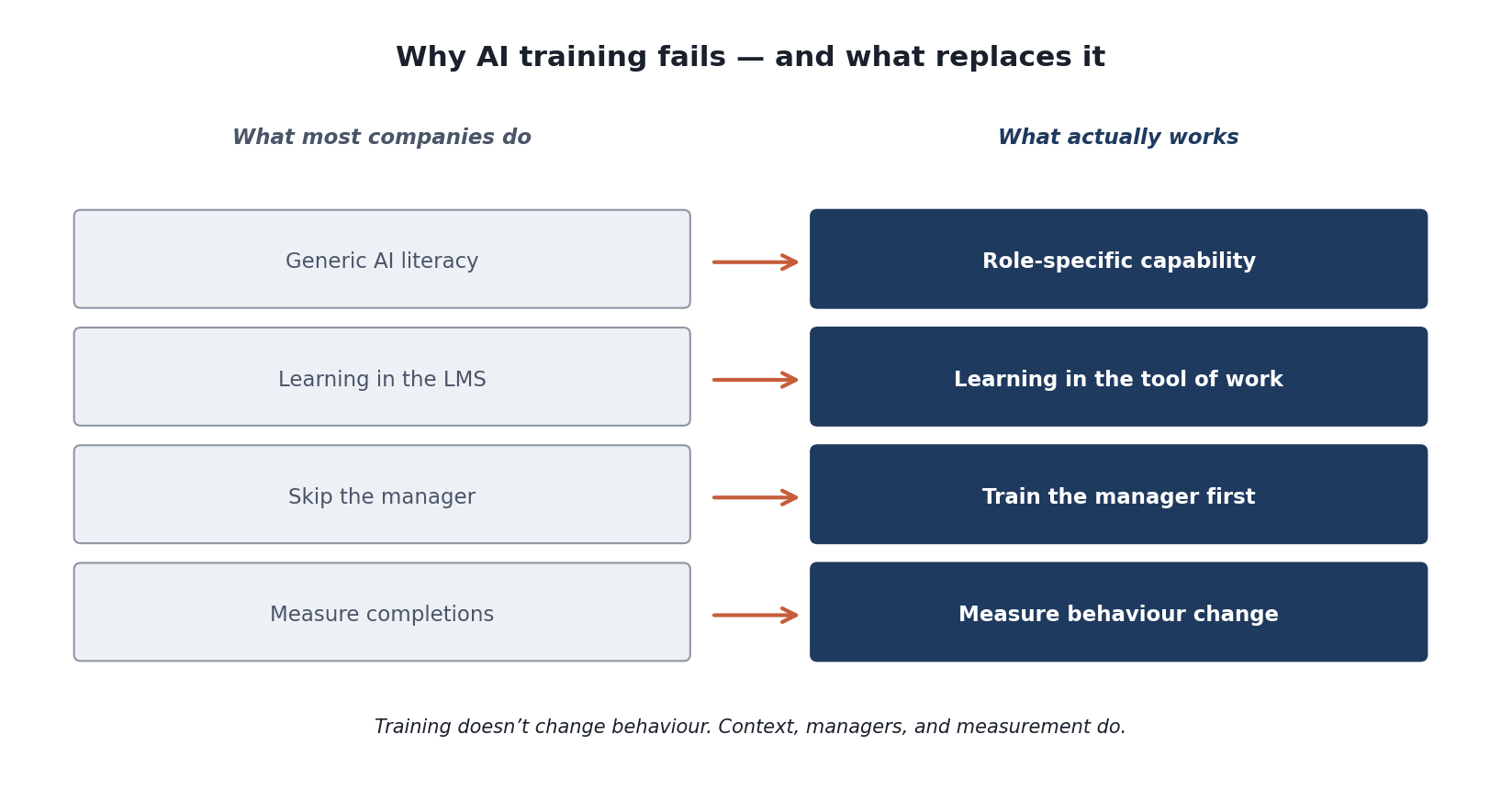
Across the 2026 enterprise research, four failure modes appear consistently:
-
Generic literacy instead of role-specific capability. Most AI training teaches what a large language model is, how prompting works, and what hallucination means. That is useful background; it is not a capability. A claims assessor doesn’t need to know how transformer attention works. They need to know what “good AI use” looks like on their next thirty claims. DataCamp’s 2026 survey of over 500 enterprise leaders found that the most common complaint about third-party AI training is that the learning paths aren’t tailored to specific roles.
-
Learning separated from the tools of work. The employee logs into the LMS, watches a 45-minute video, passes a quiz, logs out, and goes back to Salesforce — where nothing has changed. Docebo’s research found that 78% of respondents say training happens outside the tools they actually use. The cognitive distance between “where I learned this” and “where I would apply this” is where transfer dies.
-
Managers are skipped entirely. Front-line managers are the layer that turns individual learning into team behaviour. If the manager doesn’t know what good AI use looks like in their function, they can’t model it, coach it, or reward it. BCG’s 2025 global workforce survey found only around a quarter of frontline workers say their leaders give them sufficient guidance on AI. That is not a training-content problem. It is a training-audience problem: we are teaching the wrong people first.
-
Success is measured in completions, not behaviour. Most enterprise L&D dashboards report completion rates, assessment scores, and Net Promoter Scores. Almost none report whether the trained employee actually changed how they work. Without a behaviour metric, the programme is flying blind — and, crucially, has no way to improve itself.
What the “AI-fluent 5%” actually had
A recent analysis of AI usage across the knowledge workforce identified roughly 5% of workers as “AI-fluent” — those who had redesigned significant portions of their work around the technology. They save a median of 8 hours per week. Casual users of the same tools save 3.
The variable that separated them was not intelligence, not tenure, not technical background. It was two things working together: training that was specific to their role, and explicit organisational permission to change how they worked. Training alone did not produce fluency. Permission alone did not produce fluency. The combination did.
This is the uncomfortable implication for senior leaders. You cannot train your way out of this problem. You have to train and redesign simultaneously — or the training dollars are wasted.
💡 Key Insight: Role-specific training plus managerial permission is the conversion point from AI literacy to measurable behavioural change.
A playbook for training that actually changes behaviour
Five principles consistently separate AI training programmes that change behaviour from the ones that don’t:
-
Design by role, not by topic. A recruiter, a claims handler, a field engineer, and a finance analyst need four different AI training programmes — not the same “Introduction to Generative AI”. Generic content is what most vendors sell. Specific content is what actually transfers.
-
Embed learning in the tool of work. If sales uses Salesforce, AI training for sales needs to live in Salesforce. If developers live in GitHub and VS Code, that is where the learning goes. In-context guidance closes the transfer gap that standalone LMS content cannot.
-
Train the manager before the team. The manager’s job is to define what good AI use looks like in their function, reinforce it in one-to-ones, and recognise it in performance reviews. Teams drift toward what their manager rewards. Until the manager knows what to reward, no amount of team training will stick.
-
Require a workflow redesign as the training output. The goal of the training is not completion. It is a concrete change in how the team works: one workflow, redesigned, documented, deployed. If the training ends and no workflow has changed, the training failed — regardless of the assessment score.
-
Measure behaviour change, not completion. For each trained cohort, track one behaviour metric and one business metric before and after. Time to first draft. Number of tickets resolved per hour. Cycle time to close. The metric is the evidence that the training landed.
✅ Leadership Action: Make one behaviour metric and one business metric mandatory for every training cohort before approving rollout.
The leader’s 30-day move
A concrete sequence for a senior leader who wants to stop burning training spend:
-
Week 1. Pull the current AI training portfolio. For each programme, ask two questions: which specific role is this for, and which workflow is expected to change as a result? Kill or redesign anything that cannot answer both.
-
Week 2. Pick one high-leverage role — customer support, sales, underwriting, claims — and commit to building a role-specific, tool-embedded training pilot around it. One role, one workflow, one tool.
-
Week 3. Train the managers of that role first. Before any employee sits through training, the manager should be able to articulate what good AI use looks like in their team.
-
Week 4. Set the baseline. Pick one behaviour metric and one business metric, measure them now, and commit to reporting them 60 and 90 days after the training rolls out.
The consultant’s takeaway
Training, by itself, doesn’t change how people work. It never has. The enterprises that are extracting real productivity from AI are not the ones with the most completions or the most certificates. They are the ones that treated training as one input into a broader redesign — the others being workflow change, manager reinforcement, and disciplined measurement.
If your organisation is preparing to spend again on AI training in the next budget cycle, the question to put on the table is not how many people to train. It is: what workflow will have measurably changed, in which role, by when, as a result? If the training programme cannot answer that question, it is not an investment. It is an expense.
The next generation of high-performing enterprises will not be defined by how many people they trained on AI. They will be defined by how many workflows they redesigned around it — and by the discipline of the leaders who refused to confuse the two.
✅ Leadership Action: In the next 30 days, select one role, one workflow, and one embedded tool context, then prove behaviour change with pre/post metrics before scaling training further.