The Hidden Cost of AI: Why Even the Right Use Cases Fail to Deliver ROI
Leaders have mastered use case selection targeting high-volume decisions with clear KPIs, as outlined in prior frameworks. Yet MIT’s 2025 NANDA report reveals 95% of enterprise AI pilots still deliver zero bottom-line impact, despite $40 billion spent in 2024. The disconnect lies in hidden costs that erode value silently before it hits the P&L.
This isn’t about bad ideas. It’s execution economics. Even disciplined programs fall into ROI leakage traps that consultants see repeatedly across Fortune 500 transformations.
📊 The Data: MIT’s 2025 NANDA report: 95% of enterprise AI pilots deliver zero bottom-line impact, despite $40 billion spent in 2024. The problem is rarely the use case selection. It is what happens to the economics after the demo.
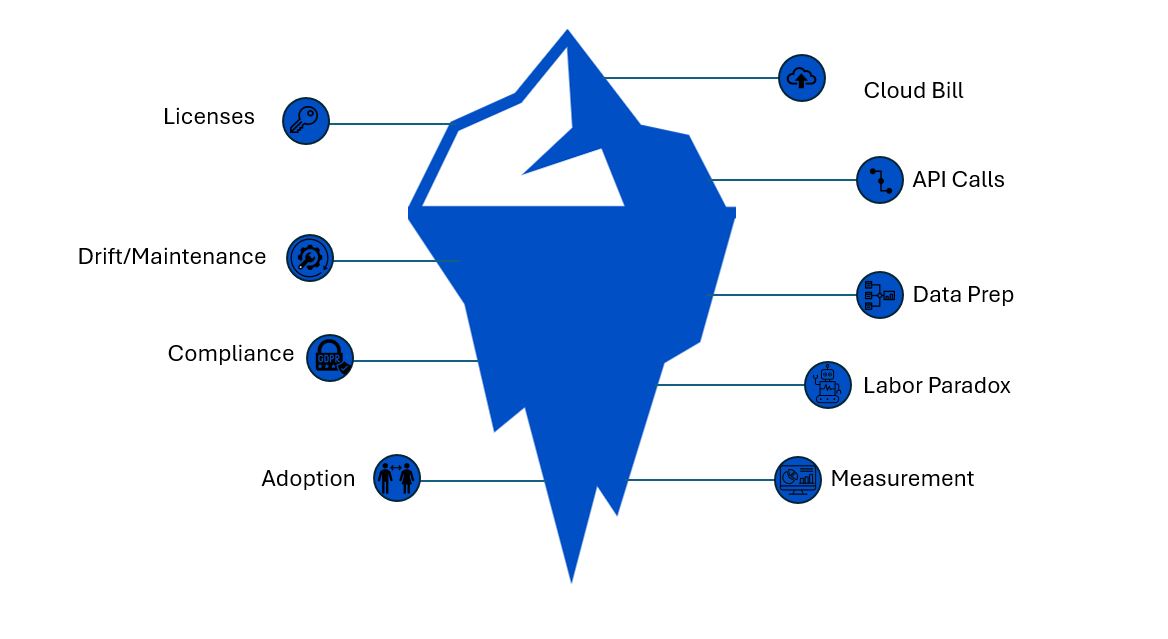
What execs budget (APIs, licenses) vs. what actually hits the P&L (data plumbing, labor shifts, drift). The gap explains 95% of failed ROI.
ROI Illusion Exposed
Enterprise AI has shifted from hype to deployment. McKinsey’s 2025 AI survey shows 70% of executives now prioritize “feasible, high-impact” use cases like demand forecasting and customer support copilots progress from the pilot chaos of 2023. Leaders apply three-filter tests: business value, data feasibility, time-to-impact within 90 days.
Yet ROI disappoints. Gartner’s 2026 forecast pegs scaled AI value at under 10% of pilots, with most stranded in “death valley” post-proof-of-concept, pre-production. Deloitte’s State of AI echoes this: while 65% report productivity gains, only 20% tie them to EBITDA or revenue.
The illusion stems from over-optimism. A compelling demo obscures the full cost stack. Execs celebrate 30% faster task completion, ignoring that net economics require 3x gains to offset overhead. Without rigorous P&L modeling, “success” becomes activity theater.
Consider a typical journey: a supply chain forecasting pilot hits 85% accuracy in weeks. Leadership greenlights scale. Six months later, maintenance eats margins, adoption lags, and value evaporates. This pattern repeats because selection rigor stops at the demo gate.
Use Case vs. Profitable Outcome
A “right” use case targets repeated, high-stakes decisions credit approvals, claims processing, personalized pricing where AI upgrades outcomes measurably. Frameworks like the Value-Feasibility Matrix ensure feasibility: owned data, process control, quick signals.
Profit demands more: surviving ROI leakage across layers. Data preparation alone consumes 40-80% of budgets, per InformationWeek analysis. Integration with legacy ERP? Another 20-30%. These aren’t line items in vendor pitches; they compound silently.
Gartner’s 85% pilot failure rate underscores execution death valley. Even high-value ideas die here because sponsors underestimate total cost of ownership (TCO). A technically sound copilot might cut response time 25%, but if QA/review adds 15% labor, net savings shrink.
Consultants frame it as decision economics: Does the use case generate cash (revenue lift, cost avoidance) exceeding TCO by 2-3x? Most fail this test post-pilot. The result: billions in sunk costs, with CFOs slashing AI budgets in 2026 planning cycles.
Invisible Cost Stack
AI costs extend far beyond API tokens. The full stack often 5-10x vendor quotes includes compounding elements that erode projected ROI.
Data preparation dominates: 40-80% of initial budgets go to cleaning fragmented sources. Enterprises sit on petabytes, but 80% prove unusable without lineage mapping, deduplication, and schema alignment. One retailer’s forecasting project spent $2M on data plumbing before models touched data.
Integration compounds this. Legacy systems SAP, Oracle demand custom middleware. A 20-30% budget slice covers APIs, security wrappers, and failover logic. Latency tradeoffs add infrastructure: GPU spikes for real-time inference push opex 5-10% higher.
Model maintenance is the silent killer. Drift hits within months; accuracy drops 10-20% yearly without retraining pipelines. This recurs 15-20% annually, per Relipa Software estimates. Compliance layers EU AI Act, GDPR tack $50K+ per project in audits, redaction tools, and explainability wrappers.
Infrastructure latency decisions amplify costs. Batch processing saves compute but kills real-time use cases. Edge deployment? Custom hardware. Cloud elasticity? Vendor lock-in premiums.
Here’s the typical stack for a mid-sized deployment:
| Cost Category | Initial Budget Share | Recurring Annual Impact | Example Mitigation |
|---|---|---|---|
| Data Prep/Cleaning | 40-80% | 5-10% | Data contracts |
| Integration/Legacy | 20-30% | 10-15% | Modular APIs |
| Maintenance/Drift | 10-15% | 15-25% | Automated MLOps |
| Compliance/Risk | 10-20% | 20%+ | Risk frameworks |
| Infrastructure | 10-20% | 5-15% | Hybrid edge/cloud |
Total TCO often hits 3-5x API costs, turning 30% efficiency gains into breakeven or losses. ZoomInfo’s 2025 study found 40% dissatisfaction traces to these unmodeled expenses.
⚠️ Watch Out: If your AI business case was modelled on API or licence costs alone, the ROI math needs to be redone before any scale investment is committed. The real cost stack — data preparation, integration, maintenance, compliance — routinely runs 3–5x vendor quotes. Build this into every greenlight decision.
Labor Paradox
The grand assumption: AI replaces headcount. Reality: it reconfigures work into invisible roles. Support copilots draft replies 2x faster, but humans spend 50% of saved time reviewing hallucinations net neutral or negative.
NBER’s 2025 productivity surveys confirm: AI adopters report no net gains. Forecasting tools demand overrides for edge cases; underwriting aids trigger compliance checks. New roles emerge: prompt engineers, output validators, drift monitors.
This isn’t theory. A global bank’s $100M claims AI saved 20% processing time but added 15% QA labor plus training for 500 underwriters. Frontline teams route around flaws: shadow spreadsheets persist, negating gains.
Consultants see this as the reconfiguration trap. AI shifts cognitive load left more exceptions, less intuition. Without process redesign, labor costs hold steady while frustration rises. McKinsey estimates 60% of AI value leaks here.
High-performers redesign end-to-end: closed-loop systems where AI proposes, humans approve in-stream. Savings compound only with 70%+ automation rates.
💡 Key Insight: AI shifts cognitive load — it does not eliminate it. Unless workflows are redesigned around AI output, labour costs hold steady while frustration rises. The reconfiguration trap is where McKinsey estimates 60% of AI value leaks. Redesign the process, not just the tool.
Throughput Trap
Speeding a task rarely moves the needle if it’s not the constraint. A 30% faster claims intake impresses until approvals bottleneck upstream. Isolated efficiency creates inventory: piled-up work awaiting human gates.
This throughput illusion plagues 70% of pilots, per McKinsey’s scaling data. Demand forecasting improves 20%, but if procurement lags, inventory metrics flatline. Copilots accelerate reports, yet decision cycles stay months-long.
Theory of Constraints applies: optimize the bottleneck, not side tasks. Consultants stress-test use cases against system diagrams where does value flow? A manufacturing AI predicting defects saves scrap but ignores shipping delays.
Real impact demands closed-loop integration: AI output triggers actions (auto-reorder, price adjust). Open-loop tools dashboards, assistants cap at 10-15% ROI ceilings.
⚠️ Watch Out: Speeding a task that is not the constraint does not improve throughput — it creates backlog. Before greenlighting any AI use case, map the full value flow and verify that the targeted step is actually the bottleneck. Optimising a non-constraint is waste, not progress.
Quality Risk
85-95% accuracy seduces. But “mostly right” cascades costs. One hallucinated pricing rec doubles revenue leakage; biased underwriting triggers $10M reserves.
Drift accelerates this: models degrade 10-15% quarterly without monitoring. Metaphase Tech reports 25% of failures stem from unchecked outputs. Healthcare pilots face 5x rework from false negatives.
Downstream amplification kills ROI. Finance: a 2% error compounds across portfolios. Operations: inventory overstocks from 5% forecast drift cost millions yearly.
Mitigation requires error budgeting: cap downstream risk at 5%, bake in human vetoes. Yet this loops back to labor paradox quality assurance eats gains.
Adoption Gap
Tools deploy; usage doesn’t. Meta-Intelligence’s 2026 Enterprise AI report cites poor workflow fit as 95% of integration failures. Generic copilots clash with CRM flows; teams print AI outputs to Excel.
Behavioral resistance compounds: 40% perceive job threats, per Deloitte. Shadow processes emerge manual overrides, workarounds. Frontline opt-out kills 50%+ of projected value.
Cultural safety nets protect pilots but block scale. Leaders must incentivize adoption: tie bonuses to AI metrics, redesign processes around outputs. Training alone fails; embed AI in daily cadence.
Measurement Problem
AI teams tout accuracy, latency; CFOs demand EBITDA delta. IBM’s research shows 80% claim gains, <30% measure ROI rigorously. Baselines vanish pre-AI productivity? Untracked.
Soft metrics dominate: “user satisfaction” masks zero P&L shift. Indirect costs rework, compliance go unallocated. Consultants insist on causal baselines: A/B cohorts, holdout controls.
Without this, ROI becomes faith-based. Portfolio reviews reveal zombies: pilots lingering sans metrics.
When AI Delivers ROI
Winners share traits. MIT’s 5% success cohort embeds AI in closed-loop, high-frequency decisions: dynamic pricing (1M+ daily), logistics routing.
Characteristics:
- Bottleneck ownership: data + process control.
- 30-90 day signals: quick pilots prove TCO.
- Error containment: <5% downstream risk.
Agentic systems outperform: AI acts, humans oversee. Early adopters see 3-5x ROI here.
Stress-Test Framework
Greenlight only with answers:
- Error landing: Who pays rework/liability?
- Labor shift: Net headcount reduction post-QA?
- Maintenance viability: <20% recurring TCO?
- Constraint test: Does it unlock throughput?
- Baseline rigor: Causal metrics pre-launch?
Apply via matrix:
| Filter | Red Flag Example | Greenlight Threshold |
|---|---|---|
| Cost Visibility | Data prep >30% budget | Full TCO <2x API |
| Error Absorption | >5% downstream risk | Contained + vetoes |
| Scale Path | No 60-day proof | Proven economics |
| Adoption Fit | No workflow redesign | Incentives + training |
| Measurement | Vague productivity claims | P&L-tied KPIs |
This kills 80% of ideas pre-spend.
✅ Leadership Action: Apply the stress-test matrix as a mandatory pre-scale gate — not a post-hoc review. An initiative that cannot clear all five filters (cost visibility, error absorption, scale path, adoption fit, measurement rigour) before investment is committed is not ready. No exceptions.
Actionable Playbook
- Audit Stack: Map all AI TCO data, infra, labor. Kill >20% overrun.
- Error Budgets: Assign costs explicitly.
- Closed Loops: Prioritize action-taking AI.
- Quarterly Kill Gates: No metrics? No budget.
- CFO Translation: Every pitch includes TCO model.
Closing: Systems, Not Tools
AI succeeds as a disciplined asset class, not a feature. Unmanaged, it drains P&L. The 5% winners audit ruthlessly, redesign systems, measure causally. In 2026, this separates leaders from the 95%.