Finding the AI Use Cases That Actually Matter - A Consultant’s Guide for Enterprise Leaders
Most large enterprises are not behind on AI; they are drowning in it. Pilots are everywhere, slideware is abundant, vendors are on speed dial — and yet very few leaders can point to three AI initiatives that have clearly moved EBITDA, reduced risk, or created new revenue streams. The problem is not a lack of AI, it is a lack of discipline in choosing where AI is allowed to matter.
Your company has probably launched five AI pilots in the last year. Maybe ten. Statistically, you are not alone in struggling to scale them: recent research from MIT researchers indicates that up to 95% of generative AI pilots in enterprises are failing to reach production at scale. AI has become a kind of innovation theater: everyone is performing, but very little shows up in the P&L. The uncomfortable truth is that most AI programs are optimized for activity, not impact. This blog is about fixing that — with a consultant’s lens.
The expensive illusion of “doing AI”
If you look at internal reports and conference slides, you’ll see an impressive story: a strong majority of large organizations say they are actively using AI or generative AI somewhere in the business. On the surface, this looks like progress. In reality, you often find a patchwork of disconnected pilots, prototypes, and experiments running in silos, with no clear line of sight to strategic priorities or financial outcomes. The optics are good, but the economics are fuzzy. In fact, Deloitte’s recent State of AI reports show that while over 70% of enterprises want AI to drive revenue growth, only about 20% have actually achieved it.
This is the expensive illusion of “doing AI”. Leaders can point to AI hackathons, innovation labs, proof-of-concept dashboards, and vendor partnerships, but struggle to answer a simple question: Which AI use cases have materially changed how we create value or manage risk? That gap between talking about AI and monetizing AI is where most of the wasted spend sits. The organizations that pull ahead in the next 24 months will be those that stop optimizing for AI activity and start optimizing for AI impact.
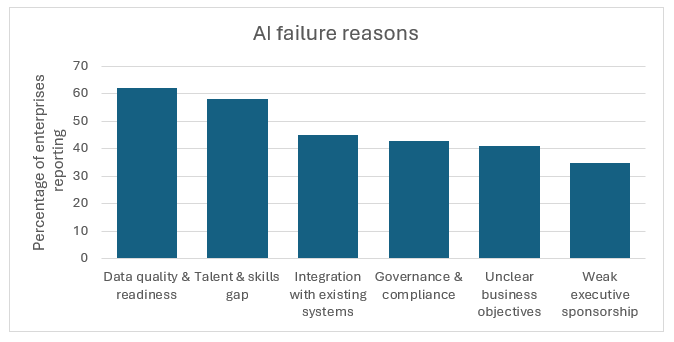
If you look at what enterprises themselves report, the pattern is clear: it isn’t the models that fail, it’s the context around them. The issues in the chart below are precisely the ones the rest of this article is designed to help you avoid.
The first sin: starting with technology, not problems
The single most common mistake in enterprise AI is starting with the shiny object. A new large language model hits the market; a vendor demos an impressive agent; an internal team builds a cool proof-of-concept. The organization then goes hunting for a problem to attach it to. The result is almost always the same: a technically impressive pilot that nobody asked for and nobody is accountable for scaling.
Consultants think about it differently: start from the decision, not the technology. Before you spin up a single model, you should be able to answer four brutally simple questions:
- Which decisions in our business are slowing us down the most?
- Which decisions are repeated at high volume across teams or markets?
- Which decisions create cost, risk, or friction when they’re inconsistent?
- Where are high-stakes decisions being made with incomplete or delayed information?
Those are your AI hunting grounds. AI is not inherently valuable; better decisions are. A credit decision made in seconds instead of days, a supply chain re-plan executed in minutes instead of weeks, a claims assessment that is measurably more accurate — these are the kinds of decision upgrades that justify AI. If a proposed AI idea cannot be anchored to a specific decision (or decision chain) that matters, it’s a science project, not a use case.
What “mattering” actually means
“High-impact AI use case” is one of the most abused phrases in the boardroom. To make it practical, you need a shared definition of what “mattering” actually means in your context. From a leadership and consulting perspective, a use case “matters” when:
- It moves a metric that is already on an executive scorecard (revenue, margin, cost-to-serve, churn, risk, compliance, cycle time).
- It can be executed with the data, talent, and infrastructure you either have or can realistically acquire.
- It can show meaningful results on a time horizon that keeps leadership attention (months, not years).
This leads to a simple three-filter test that should be applied to every AI idea:
Business value
Does this use case clearly drive one (or more) of: revenue growth, cost reduction, risk mitigation, or faster time-to-decision? If you cannot name the business KPI, you do not yet have a use case — you have an experiment.
Feasibility
Do you have usable data (not just data in theory), the technical capabilities, and the process ownership to actually deliver? Many “great” ideas die because data is fragmented, unstructured, or politically inaccessible.
Time to impact
Can you get a first measurable signal within 30–90 days of starting? Quick wins aren’t about vanity; they are about building confidence, credibility, and organizational momentum so people are willing to back the next wave of initiatives.
If an idea fails any one of these three tests, it should be deprioritized. In an environment where capital, talent, and attention are all constrained, “nice to have” AI is an unaffordable luxury.
💡 Key Insight: The three-filter test is a forcing function, not a scoring tool. If a use case fails any one of the three filters — business value, feasibility, or time to impact — it should not advance. Partial passes are not passes.
A consultant’s framework for prioritizing AI use cases
Once you filter out the noise, you will still be left with more plausible AI ideas than you can execute. This is where you need structure. The approach many consulting teams use boils down to a Value / Feasibility Matrix with a few critical additions.
Consider your candidate use cases against two dimensions:
| High Feasibility | Low Feasibility | |
|---|---|---|
| High Value | Prioritize Now | R&D Candidate |
| Low Value | Consider Carefully | Deprioritize |
- High value / high feasibility: These are your priority bets. They should be funded, staffed, and tracked with executive visibility.
- High value / low feasibility: Treat these as strategic R&D. They may require foundational data work, new capabilities, or external partnerships.
- Low value / high feasibility: These can be tactical wins if they unlock learning or adoption in critical parts of the business, but they should not consume disproportionate funds.
- Low value / low feasibility: Kill them early. Being polite here is expensive.
To bring rigor into this, institute a “7 questions before greenlighting” checklist for every AI initiative:
- What exact business metric will this improve, and by how much (even as a hypothesis)?
- Do we have access to the necessary data at sufficient quality and volume?
- Does this problem actually require AI, or could simpler automation or process redesign solve 80% of the value?
- Can we build a pilot that demonstrates value within 30–60 days?
- Who is the business owner (not the technical owner) accountable for outcomes?
- What risk, compliance, and ethical considerations must be addressed upfront?
- If the pilot succeeds, what is the path to scale — in budget, systems integration, and change management terms?
If a sponsor cannot answer these questions on one page, the initiative is not ready. This filter alone will protect you from a remarkable amount of waste.
✅ Leadership Action: Require every AI sponsor to answer the 7-question checklist on a single page before any greenlight. If they cannot, the initiative is not ready — not the checklist. This single gate eliminates the majority of wasted AI spend before it happens.
Escaping “pilot purgatory”
Between a promising demo and a scaled deployment lies a dangerous place: pilot purgatory. This is where AI projects go to linger. They are not outright failures, so nobody wants to kill them. But they never quite hit the thresholds needed for serious investment, so they never scale either. Over time, your portfolio fills up with zombie pilots that consume talented people, infrastructure, and political oxygen. Gartner has continuously warned that as many as 80% of AI projects never reach production deployment. Over time, your portfolio fills up with these zombie pilots that consume talented people, infrastructure, and political oxygen.
Pilot purgatory typically has three root causes:
Fragmented infrastructure
Pilots are built on isolated datasets, ad hoc pipelines, or external sandboxes that were never intended to plug into core systems. When it’s time to scale, the integration cost shocks everyone.
No decision criteria
Many pilots are launched with vague objectives (“explore possibilities”, “test the technology”) and no pre-defined success metrics. Twelve months later, there is no evidence-based way to decide whether to double down or shut down.
Cultural safety nets
Pilots are politically safe. They signal innovation without forcing anyone to commit to operational change, retrain staff, or redesign incentives. Moving to production means someone owns the outcome — and not every leader is eager to volunteer.
The remedy is blunt but effective: time-box all pilots and attach them to a clear scale or kill decision gate. For example:
- Pilots run 30–45 days with a very specific KPI (e.g., reduce average handling time by 10%, increase forecast accuracy by 5%, cut processing time by 30% on a limited scope).
- At the end of the period, a cross-functional governance group reviews results and decides:
- Scale (with funding and a clear owner)
- Iterate (with specific hypotheses and a short leash)
- Kill (and document learnings)
Anything that has been in “pilot” for more than 90 days without a formal decision should be assumed dead — or made dead. This discipline keeps your portfolio focused and your teams honest.
⚠️ Watch Out: Zombie pilots are more expensive than failed ones. A failed pilot generates a learning. A zombie pilot consumes budget, talent, and political capital while producing nothing — and becomes harder to kill with every passing quarter.
Governing what you scale: risk, data, and accountability
Scaling AI without governance is not bold; it is negligent. Once you move beyond low-stakes experimentation, you are touching customer interactions, pricing, credit lines, diagnoses, recommendations, and strategic planning. These are domains where bias, drift, or errors can become regulatory, reputational, or financial crises.
Effective AI governance is not about creating hoops that slow teams down. It is about creating the confidence and clarity that allow you to move faster safely. Four pillars matter most:
Data ownership and quality
No AI initiative can outperform the data it is built on. You need clear data ownership (who is accountable for which domain), data quality standards, and processes to address issues quickly. Many AI “failures” are actually data governance failures in disguise.
Risk and compliance frameworks
Work with risk, legal, and compliance early to define what classes of AI use cases are permissible, which require special approval, and which are off-limits. Codify principles around fairness, explainability, and auditability, especially in regulated industries.
Model transparency and monitoring
Even if you are using opaque models, you must be able to explain, at the appropriate level, how the system behaves and how it is performing. This includes monitoring for drift, performance degradation, security vulnerabilities, and unintended behaviors.
Change management and adoption
Technology is the easy part. Getting people to trust and use AI recommendations is harder. You need communication, training, incentives, and often process redesign. If front-line staff feel that AI is threatening their roles or undermining their judgement, they will resist or route around it — quietly.
Governance should be designed as a guardrail, not a roadblock. Think lightweight, repeatable workflows and clear decision rights, not thick binders of policy that nobody reads.
Measuring what the CFO actually cares about
Ask your AI teams how they measure success and you will hear about model accuracy, latency, token usage, or user satisfaction scores. Ask your CFO and you will hear a completely different language: revenue uplift, cost per transaction, margin, risk-adjusted return, working capital, compliance cost. If you don’t translate AI performance into financial impact, your initiatives will always be vulnerable in budgeting cycles. This disconnect is measurable: IBM research recently found that while nearly 80% of organizations report AI productivity gains, fewer than 30% can confidently measure their AI return on investment.
📊 The Data: 80% of organizations claim AI productivity gains. Fewer than 30% can measure their ROI rigorously (IBM). If your AI programme falls into that 50-point gap, you are running on narrative, not evidence — and your budget is vulnerable in the next planning cycle.
To close this gap, it helps to think in a simple loop: See → Measure → Decide → Act.
See
First, make your AI landscape visible. Many enterprises are surprised to discover that they have far more AI touchpoints than they realize — embedded in SaaS tools, vendor solutions, and shadow IT. You cannot manage what you cannot see.
Measure
For each major use case, define a small set of business KPIs and link them to baseline data. For example:
- Customer support copilot: average handle time, first contact resolution, customer satisfaction, cost per contact.
- Demand forecasting: forecast accuracy, inventory days on hand, stock-out rate, markdowns.
- Underwriting: approval rate, loss ratio, manual review time.
Decide
Use this data to make portfolio decisions. Which use cases are outperforming expectations? Which are tracking to neutral or negative value? Which ones are generating intangible but strategically important benefits (e.g., regulatory readiness, data foundation)?
Act
Scale what is working, redesign or exit what is not. Reinvest freed-up budget and talent into higher-potential opportunities, instead of letting underperforming use cases linger because they were politically easy to start.
When you can show, in financial terms, what each AI initiative is returning, AI stops being an experiment and starts being an asset class in your business.
What high performers do differently in 2026
Across industries, a pattern is emerging. The enterprises that are extracting disproportionate value from AI share a few consistent behaviors:
They start from business problems, not from tools.
Every AI use case is framed as a problem statement tied to a P&L line item or risk indicator. Technology is chosen after, not before.
Senior leaders own AI outcomes.
Successful organizations do not outsource AI to ‘the AI team’ or to IT alone. McKinsey’s global AI surveys consistently show that AI high-performers are roughly three times more likely to have C-suite executives actively championing AI initiatives. Business unit leaders, P&L owners, and C-level executives must have explicit accountability for the results.
They run fewer, better bets.
Instead of dozens of diffuse pilots, they run a smaller number of well-chosen use cases, take them to production, and then expand their scope or geography.
They speak the language of value.
AI is discussed in terms of revenue impact, cost savings, risk reduction, and strategic capability — not only in terms of accuracy, parameters, or benchmarks.
They move from opportunistic to portfolio thinking.
Rather than reacting to each new technology wave, they maintain a living portfolio of AI use cases, with clear entry criteria, exit criteria, and capital allocation logic.
They invest in agentic, decision-centric AI.
The next wave of enterprise AI is about autonomous decision-making systems — agents that can perceive, reason, and act within clearly defined boundaries. These are not chatbots; they are outcome-driven systems.
🚩 Red Flag: If your organization measures AI success primarily through model accuracy, latency, or user satisfaction scores — and not through revenue impact, cost reduction, or risk metrics — the programme is optimised for the wrong audience. Reframe before the CFO does it for you.
Most enterprises are not struggling with AI capability; they are struggling with AI discipline. The next 12 months will belong to the leaders who can make three shifts:
- From “do more AI” to “do the right AI”
- From activity metrics to business metrics
- From pilots to production-grade outcomes
If you can answer the eight questions in this guide, you already have the discipline framework. The question is how ruthlessly you are willing to apply it.