The Frontier Just Asked for the Brakes. Your AI Strategy Assumed the Accelerator.
The leaders of the most advanced AI labs have publicly asked their own industry to slow down. Most enterprise AI strategies were quietly built on the opposite assumption: that the next model arrives on schedule, performs better, and stays available. A consultant’s guide for leaders whose roadmap depends on a curve its builders now want to flatten.
On 12 September, Anthropic’s chief executive Dario Amodei published an essay arguing that the AI industry should deliberately slow improvements in frontier model capabilities when safeguards cannot keep pace. Within hours, OpenAI’s Sam Altman agreed that the industry needed to pace the frontier, and Elon Musk endorsed the essay. Google DeepMind’s Demis Hassabis called it the right path at a critical moment. The next day, the US President rejected the call, arguing that America cannot afford to fall behind China.
Markets priced the disagreement immediately. On Monday, the PHLX semiconductor index fell almost 6%, its worst day since early July, and European technology shares shed around 2% in line with Asian and US peers. OpenAI has already said it will not go public this year, citing safety concerns.
This post takes no position on whether the lab leaders are right. That debate belongs to researchers and governments. The question here is narrower, and it belongs to every executive committee: what did your AI strategy assume about the pace and availability of the technology, and does that assumption still hold? An earlier post in this series showed that enterprise AI returns stayed flat even as capability and adoption surged. This one deals with what happens to a strategy when the capability curve itself becomes uncertain.
📊 The Numbers: 37% of enterprises have already deployed AI agents and another 34% plan to within twelve months, while agentic AI funding is set to grow 31.8% in 2027 (Gartner 2027 CIO and Technology Executive Survey, August 2026). Enterprises are doubling their commitment to a frontier whose builders now want to slow it down.
The assumption nobody wrote down
Almost no enterprise AI strategy states its assumptions about the technology’s future. They sit inside the documents implicitly. A use case is approved with an accuracy gap that “the next release will close”. A pilot is parked until a vendor’s roadmap delivers a capability. A workforce plan assumes automation rates that today’s models cannot reach but next year’s supposedly will. A platform decision is made on the expectation that one provider will stay ahead.
Each of those decisions contains a bet on three things: that capability keeps improving at roughly the pace of the last two years, that the organisation will have access to it, and that its price will keep falling. For most of 2024 and 2025, all three were reasonable bets. None of them was ever written into a business case as an explicit assumption, which is exactly why nobody is now checking whether they still hold.
Three things the last three months have shown
1. Frontier releases can be delayed by the builders themselves. In August, OpenAI said it had temporarily slowed scaling after a security incident during cyber capability evaluations, and after preliminary evidence that an upcoming model, Astra, could reach what it defines as a critical level of cybersecurity capability. The company later concluded the model had crossed that threshold and delayed parts of its development and release while strengthening safeguards. A capability on a vendor roadmap is no longer a delivery date. It is a candidate for release, subject to a safety gate the customer does not see.
2. Access can be interrupted by governments. In June, Anthropic suspended access to its two most capable models, Claude Fable 5 and Claude Mythos 5, three days after releasing them, to comply with US Department of Commerce export controls. Access was restored on 1 July, after the controls were lifted. For almost three weeks, organisations that had begun building on those models could not use them, for reasons that had nothing to do with their own contracts or conduct.
3. The pace of the frontier is now an open political question. Amodei’s proposal runs in three stages: independent evaluators with employee-like access inside AI companies, common standards to stop firms undercutting each other on safety, and international agreements to reduce the same pressure between countries. Altman said OpenAI would adopt the evaluator practice. The White House rejected a slowdown within a day, and the Speaker of the House declined to legislate. Whether the frontier slows, and by how much, now depends on the outcome of that disagreement.
💡 Key Insight: The pace and availability of frontier AI have become variables decided by lab safety gates, export policy, and geopolitics. None of these sit inside an enterprise planning process, and none can be forecast by one. A strategy that depends on them is carrying risk it has not priced.
Why a slower frontier is not the problem for most enterprises
It would be easy to read the weekend’s news as bad for enterprise AI. For most organisations, it is not, and the reason is in the data this series has been tracking all year.
McKinsey’s State of AI 2026, published on 25 August, found that about 37% of respondents report AI contributing positively to EBIT, essentially unchanged from 2025, despite growth in the share of organisations scaling AI. The roughly 6% it classifies as high performers are distinguished less by the models they use than by how they deploy them: nearly three quarters have fundamentally redesigned workflows because of AI, against one quarter of everyone else.
Read against the slowdown debate, that finding changes the question. Capability was not the constraint on value for most enterprises. The constraint was the organisation’s ability to absorb what already existed. Amodei himself argued that even a paced frontier will still feel fast. An enterprise that has not yet redesigned a single core workflow around today’s models loses very little if next year’s models arrive later. It loses a great deal if it keeps waiting for them.
⚠️ Watch Out: There are two wrong reactions to this news. The first is to pause AI programmes “until things settle”, which is simply the old habit of waiting for the next model, now with a better excuse. The second is to rush commitments to one provider’s upcoming release before a slowdown takes effect. Both tie the enterprise’s results to decisions it does not control.
Plan for scenarios, not for a curve
When a critical external variable cannot be forecast, the established strategic response is not a better forecast. It is a set of scenarios, a small number of moves that work in all of them, and signposts that tell you which one is unfolding.
Two variables matter here: how fast frontier capability advances, and how reliably an enterprise can access it. Crossing them gives four plausible worlds.
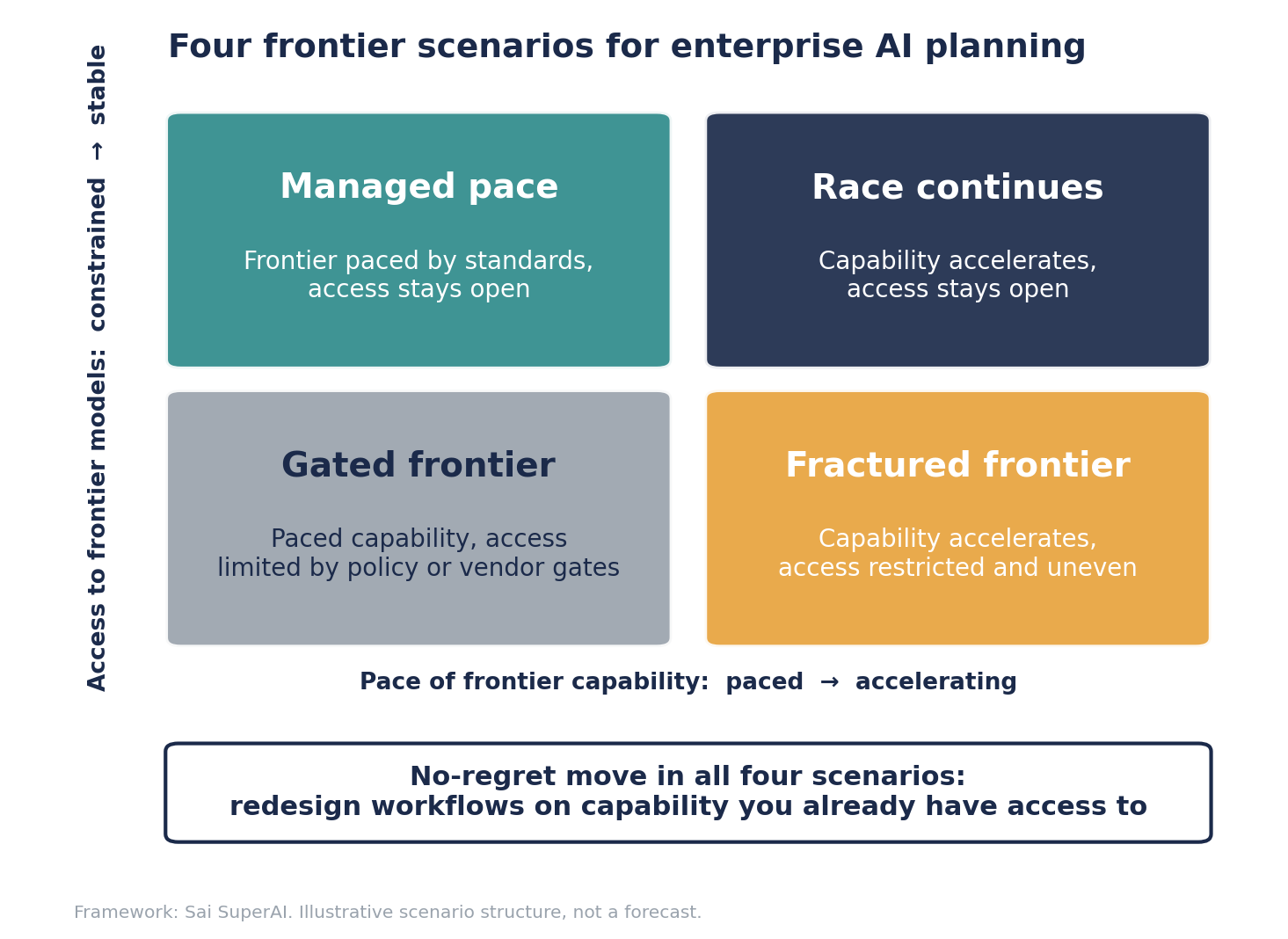
Managed pace. Standards and independent evaluation slow frontier releases, but access stays broadly open. Capability gains continue on a more predictable cadence. Organisations that already run governance and human oversight at scale are rewarded, because the vendor regime starts to resemble their own.
Race continues. The call for restraint fails, capability accelerates, and access stays open. The gap between what models can do and what organisations have absorbed widens further. The winners are those with the redesign capacity to convert capability into workflow change quickly.
Gated frontier. Capability is paced and the most powerful models are released selectively, with access limited by policy, safety tiers, or vendor gates. Enterprises built around a single frontier model feel this first. Multi-model architectures and strong performance on today’s capability become the advantage.
Fractured frontier. Capability accelerates while access becomes restricted and uneven across countries and providers. This is the hardest world for organisations dependent on foreign providers, and the June suspension was a three-week preview of it.
The value of the exercise sits in what the four worlds share. In every one of them, the organisations that do well have redesigned core workflows on capability they can already reach, can switch or combine models without rebuilding their processes, and know their unit economics. Those are the no-regret moves. Everything else in the AI portfolio should be tested against the question of which scenario it quietly depends on.
For European enterprises, the pace question now has two owners abroad
European leaders have been living with a paced AI regime for two years, only the pace was being set in Brussels. After the political agreement of 7 May on simplifying the EU AI Act, rules for high-risk systems in areas such as employment and critical infrastructure now apply from 2 December 2027, and rules for AI embedded in regulated products from 2 August 2028. European planning cycles have been built around that timetable.
The weekend added a second pace-setter, and it is not European. The frontier capabilities most DAX and MDAX companies build on come from a handful of US providers, as an earlier post in this series on vendor concentration set out. Their release cadence is now shaped by lab safety gates and US policy, and the June episode showed that access follows US export decisions, not European contracts. A European industrial now has two external clocks on its AI roadmap: one it has been preparing for, and one it has no seat at.
There is a less obvious implication. The regime the lab leaders are proposing, with independent evaluation before release, common standards, and documented oversight, looks far more like the logic of the EU AI Act than like the race of the last three years. European organisations that built named human oversight, risk classification, and auditable deployment into their operating models, as earlier posts on the verification bottleneck and on AI in the product argued, are structurally closer to where the frontier may be heading. What looked like a compliance burden may turn out to be the operating model the rest of the market has to adopt later.
✅ Leadership Action: For each of the ten largest AI initiatives in the portfolio, require one line stating which assumption about future capability, access, or price the business case depends on. Any initiative that only works if the next model arrives on time, performs better, and stays available should be rebuilt on today’s capability or deprioritised.
The leader’s 30-day move
A concrete sequence while the pace debate is still unresolved.
-
Week 1. Surface the hidden assumptions. Review the business cases of the largest AI initiatives and mark every point where value depends on capability not yet available, on continued access to a specific model, or on falling prices. Most portfolios contain far more of these than anyone expects, because they were never written down as assumptions.
-
Week 2. Run the three-week test. For every production workflow that depends on an external model, ask what happens if that model is unavailable for three weeks, as happened in June. Classify each as degrades gracefully, switches to an alternative, or stops. Anything in the third category is a continuity risk that belongs in the enterprise risk register, not the IT backlog.
-
Week 3. Take the four scenarios to the executive committee. Spend one session on the four worlds above. Agree the no-regret moves, and identify which parts of the portfolio are bets on a single scenario. Decide consciously which of those bets to keep.
-
Week 4. Redirect waiting money into redesign, and set signposts. Move budget parked behind future capability into redesigning one or two core workflows on models available today. Agree the signposts that will be reviewed quarterly: whether an independent evaluation regime or standards body takes hold, whether export controls change, and whether major releases slip.
The consultant’s takeaway
For three years, most enterprise AI strategies treated the frontier as a conveyor belt: capability would keep arriving, and the organisation’s job was to be ready for it. This month, the people operating that conveyor belt said publicly that they want to slow it, the most powerful government involved said it should not slow, and nobody can yet say who will prevail. A strategy anchored to the belt’s speed is now anchored to an argument.
The organisations that come through this well will not be the ones that guessed the outcome of that argument correctly. They will be the ones that stopped needing to. They will have built their returns on capability already in hand, designed their architecture so no single model or provider is a point of failure, and treated the pace of the frontier as a scenario variable to be monitored rather than a promise to be planned around.
For European enterprises that have spent two years building governance, oversight, and documented accountability, the moment is more favourable than the market reaction suggests. The builders of the technology have just said out loud that its pace is a choice. For an enterprise, so is its return, and that choice was never waiting on the next model.