AI Just Became a Variable Cost. Your 2027 Budget Still Thinks It Is Software.
Enterprise AI used to arrive as a licence with a fixed price. Agents arrive as a meter that runs faster the better they work. The 2027 budgets being written this month are built on the first model and will be billed on the second. A consultant’s guide for leaders about to approve an AI number that nobody in the room can forecast.
Budget season has started, and the arithmetic on the table does not close. Gartner’s 2027 CIO and Technology Executive Survey, published on 31 August, found that IT budgets are projected to grow by an average of just 3.7% next year. Funding for agentic AI is expected to grow by 31.8%, making it the fastest-growing technology investment area. At the same time, 37% of respondents have already deployed AI agents and another 34% plan to within twelve months, which roughly doubles the number of organisations running them.
Gartner draws the conclusion most finance teams have not yet drawn. Without stronger cost controls, successful AI initiatives can increase demand beyond what existing budget models can support. Read that sentence again. The budget risk in 2027 is not that AI fails. It is that AI works, and the invoice scales with it.
Earlier posts in this series dealt with the hidden cost stack behind AI projects and with licences that nobody activates. Both assumed the cost of AI was essentially fixed once contracted. That assumption is ending. This post deals with what replaces it: a cost line that behaves like energy or logistics, sitting inside a planning process designed for software.
📊 The Numbers: 58% of CIOs face growing pressure to deliver AI-driven cost savings, while 51% expect AI to increase total cost of ownership. Only 13% report significant value from AI tools so far (Gartner 2027 CIO and Technology Executive Survey, August 2026).
The cost curve inverted, and the budget did not notice
A seat licence has a comfortable property. The cost is known the day the contract is signed, and the cost per unit of use falls as adoption rises. Every budgeting instinct built over twenty years of enterprise software rests on that property.
Agents break it. An agent is paid for by what it does, and what it does grows with every task it is trusted with. In a Gartner forecast published on 17 August, the firm predicts that AI inference costs per agentic workflow will increase more than fivefold through 2028, even as the price of the underlying tokens keeps falling. Gartner calls this the Inference Paradox: better unit economics tempt organisations into more complex workflows, which consume far more tokens, reasoning steps, and model calls than simple assistants ever did. Its analyst Will Sommer put the consequence plainly for product leaders: cheaper token economics cannot be relied on to rationalise AI costs.
EY’s analysis of customer service AI makes the shift concrete. A simple linear workflow in 2023 cost around 4 cents per interaction. A 2026 orchestrated system with tools, reasoning, and iterative loops costs around 1.20 dollars per interaction, roughly thirty times more. EY’s framing is the one every CFO should borrow: agentic AI moves enterprise AI from a fixed-cost comparison to a dynamic compute consumption model.
The implication is uncomfortable for anyone who has spent the year negotiating token prices. The per-token price is the wrong number. The number that matters is the cost of a completed unit of work, and almost no enterprise budget currently contains it.
💡 Key Insight: In a seat model, the budget risk is paying for software nobody uses. In a consumption model, the budget risk is paying for software everyone uses. The more successful the deployment, the larger the unplanned invoice.
Four assumptions in the 2027 budget that no longer hold
1. AI is an IT line item. Gartner found that an average of 15.3% of technology solutions are already developed outside central IT, and 80% of technology executives expect AI to expand business-developed solutions by 2030. Yet 73% of enterprises have no plans to develop rules for who owns technology costs and solutions. In practice, business units create the consumption while the CIO holds the budget and the blame. Consumption without ownership is how a cost line grows without anyone deciding it should.
2. Next year is this year plus a percentage. Most 2027 AI budgets are being built from the 2026 run rate. But the 2026 run rate was dominated by assistants and pilots. If agent deployments roughly double, as the Gartner data suggests, last year’s number is not a baseline. It is a historical artefact of a cheaper operating model.
3. Cheaper models will absorb the growth. This is the assumption the Inference Paradox exists to break. Model prices do fall. The workloads organisations build on top of them grow faster. Budgeting on the expectation of falling prices is budgeting on the half of the curve that does not reach the invoice.
4. The savings will fund the spend. The survey data does not support this. Only 36% of Gartner’s respondents believe they will meet their expected cost-reduction targets. KPMG’s Global AI Pulse, as reported by Flexera in August, found that 49% of organisations have already delayed or scaled back AI because of cost, and Flexera’s own 2026 research found 59% saying wasted AI spend rose year over year.
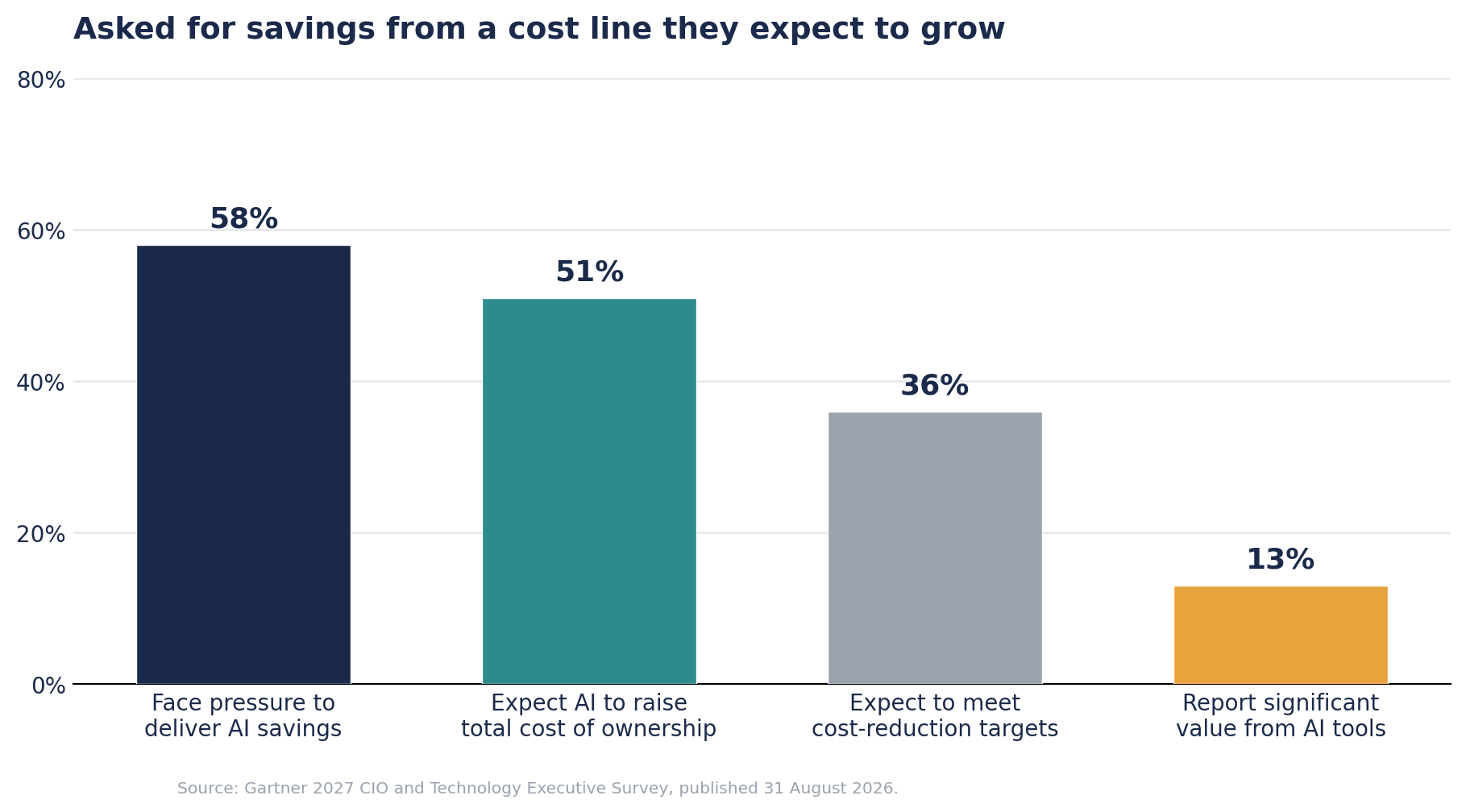
The chart is the planning problem on one page. Leadership expects AI to fund itself. The people running it expect it to cost more over its life, and very few can yet point to significant value. A budget that resolves that tension by assumption, rather than by design, will be renegotiated by the first quarterly invoice.
⚠️ Watch Out: The instinctive response to a consumption surprise is a blanket cap. Caps protect the budget and punish the deployments that work, because the workflows consuming the most are usually the ones the business adopted fastest. A cap without a view of unit cost simply rations success.
What a consumption-grade AI budget looks like
The organisations getting ahead of this are not spending less on AI. They are budgeting it the way mature operators have always budgeted variable costs: by driver, by owner, and by unit.
Budget the unit of work, not the token. The planning unit should be the business outcome the agent produces: cost per resolved service case, per processed claim, per quote issued, per engineering change released. Once that unit exists, consumption becomes a driver-based forecast. Volume of cases times cost per case is a number a controller can plan, challenge, and track. Tokens per month is not.
Put the meter where the decision is made. The business owner who decides to route work to an agent should see what that decision costs. Gartner’s recommendation is to align technology ownership with cost allocation and to partner with the CFO on enterprise-wide AI economics covering token consumption, platform costs, governance overhead, workforce impact, and value realisation. Showback first, chargeback once the unit costs are trusted. The purpose is not internal billing. It is making the people who create the demand accountable for its economics.
Tier intelligence the way you tier labour. No organisation assigns its most expensive specialist to every task. The same discipline applies to models. Routing routine work to smaller models and reserving premium reasoning capability for the decisions that justify it is Gartner’s own prescription for the Inference Paradox. That routing policy is a management decision about which work deserves premium capability, and it should be owned as one rather than left to whichever engineer configured the pipeline.
Release budget in stage gates, not annual lumps. Gartner advises requiring every AI investment to demonstrate business value within 90 days or face termination, and ruthlessly eliminating zombie AI projects. Applied to consumption, that means releasing agent budget in tranches tied to unit economics. A deployment that proves its cost per unit earns the next tranche. One that cannot state it does not.
✅ Leadership Action: Before signing the 2027 AI budget, require four numbers for every agent deployment above a materiality threshold: the unit of work it produces, today’s cost per unit, the value per unit, and the name of the business owner accountable for the variance. A deployment without all four is not a budget line. It is an open tab.
Europe’s advantage sits in the controlling department
For European industrials, this shift arrives at a specific moment. A survey of more than 7,000 German firms by the ifo Institute, summarised in a CEPR column earlier this year, found that among firms using or planning to use generative AI, related spending rises from roughly 1.0% of sales in 2024 to 1.5% in 2026. Across the whole German economy, the researchers estimate AI-related expenditure climbing from 0.3% to 0.8% of aggregate sales, which puts it in the same range as some established cost categories. The same survey found spending forecasts pointing to diminishing returns once the easily scalable applications are in place.
Put those findings next to the Inference Paradox and the timing is awkward. AI is becoming a material cost line at exactly the point where the cheap, obvious wins run out and the expensive, agentic ones begin.
The advantage European industrials hold is one they rarely think of as an AI capability. German and continental companies run some of the most sophisticated controlling functions in the world: cost centre accounting, driver-based allocation, variance analysis, and the institutional habit of asking what a unit of output actually costs. That machinery was built for plants, logistics, and energy. It is precisely what a consumption-based AI cost line needs. In most organisations it has never been pointed at AI, because AI arrived in IT, as licences, where controlling had nothing to allocate.
There is a second reason to point it there now. As an earlier post in this series on vendor concentration argued, the price of most frontier AI capability is set by a very small number of providers, almost none of them European. A cost line that is both variable and priced by someone else is a strategic exposure, not just a budget item. A unit-cost view is what makes that exposure visible before a renewal makes it painful.
The leader’s 30-day move
A concrete sequence before the 2027 budget is locked.
-
Week 1. Build the real run rate. Consolidate every AI consumption line across model providers, cloud platforms, and business-unit budgets, including agent pilots funded outside IT. Tag each line with the business owner who generates the demand. Most organisations discover that nobody currently holds this view, and that a meaningful share of spend sits outside the IT budget entirely.
-
Week 2. Define the unit economics for the five largest deployments. For the five agent or AI workloads with the highest or fastest-growing consumption, agree the unit of work, the current cost per unit, and the value per unit. Where the value cannot be stated, that is the finding.
-
Week 3. Move the meter to the business. Assign consumption budgets to the owners who generate them, with showback this quarter and chargeback from 2027. Name one accountable owner for enterprise AI economics, sitting jointly between the CFO and CIO, and give controlling a formal mandate over the AI cost line.
-
Week 4. Replace caps with gates. Swap flat spending limits for unit-cost thresholds and 90-day stage gates. Set the routing policy for which classes of work may use premium models. Present the resulting budget to the executive committee as a driver-based forecast, not a lump sum.
The consultant’s takeaway
The AI budget conversation of the last three years was about whether the investment would pay off. The 2027 conversation is different in kind. The question is no longer only whether AI creates value, but whether the organisation can govern a cost that grows with every success. A licence could be approved once and forgotten. A meter has to be managed every month, by someone who owns both what it consumes and what it produces.
The enterprises that handle this well will not be the ones that negotiated the lowest token price or imposed the tightest caps. They will be the ones that turned AI into a unit economics discipline: a known cost per unit of work, an owner for every meter, and funding that follows proven returns rather than annual habit. None of that requires new technology. It requires pointing existing financial discipline at a cost line that has, until now, been hiding in IT.
European industrials are better equipped for that than they tend to believe, because the controlling capability already exists. What is missing is the decision to use it. The question for this year’s budget committee is not how much AI the company can afford. It is whether anyone at the table knows what a unit of AI-produced work costs, and who answers for it when that number moves.