The Seniority Cliff: You Automated the Work That Made Your Experts
Junior employment is falling at AI-adopting firms while senior employment holds. The tasks being automated were never valuable in themselves. They were how judgment got transferred. A consultant’s guide for leaders who are optimising a five-year cost line against a ten-year capability line.
The restructuring numbers that dominate boardroom discussion are the wrong ones. What matters is not how many roles came out of the organisation. It is which rung of the ladder they came from.
A Harvard working paper by Seyed Hosseini and Guy Lichtinger, covering résumé and job posting data for more than 60 million workers across over 280,000 firms between 2015 and 2025, found that firms adopting generative AI cut junior employment by roughly 9% within six quarters, while senior employment at the same firms showed no comparable break and continued to rise. The researchers named the pattern seniority-biased technological change. The Stanford Digital Economy Lab, analysing payroll records in its Canaries in the Coal Mine study, found a 13% relative employment decline for workers aged 22 to 25 in the most AI-exposed occupations since late 2022, with older workers in the same occupations holding steady or growing.
The mechanism matters more than the magnitude. This was not a wave of redundancies. Separation rates for juniors barely moved. It happened almost entirely through hiring that quietly stopped, and it started before the automation actually arrived. Firms adjusted their intake for the productivity they expected rather than the productivity they had. The previous posts in this series dealt with restructuring sequence, with the verification bottleneck, and with why training programmes fail to change behaviour. This post deals with the second-order effect none of those cover: what happens to the supply of experienced judgment when the work that produced it is the first thing you automate.
📊 The Numbers: Junior employment fell around 9% at generative-AI-adopting firms within six quarters, while senior employment at the same firms kept rising (Hosseini and Lichtinger, Harvard 2026). Employment for 22 to 25 year olds in the most AI-exposed occupations declined 13% relative to peers since late 2022 (Stanford Digital Economy Lab).
The data has stopped being ambiguous
For most of 2024 and 2025, the entry-level story was contested. It could plausibly be read as post-pandemic correction, interest rate pressure, or the ordinary cyclical thinning of graduate intake. That reading no longer survives contact with the evidence, because the effect is now visible within firms rather than across the economy. The comparison is between companies that adopted generative AI and companies that did not, in the same sectors, over the same period.
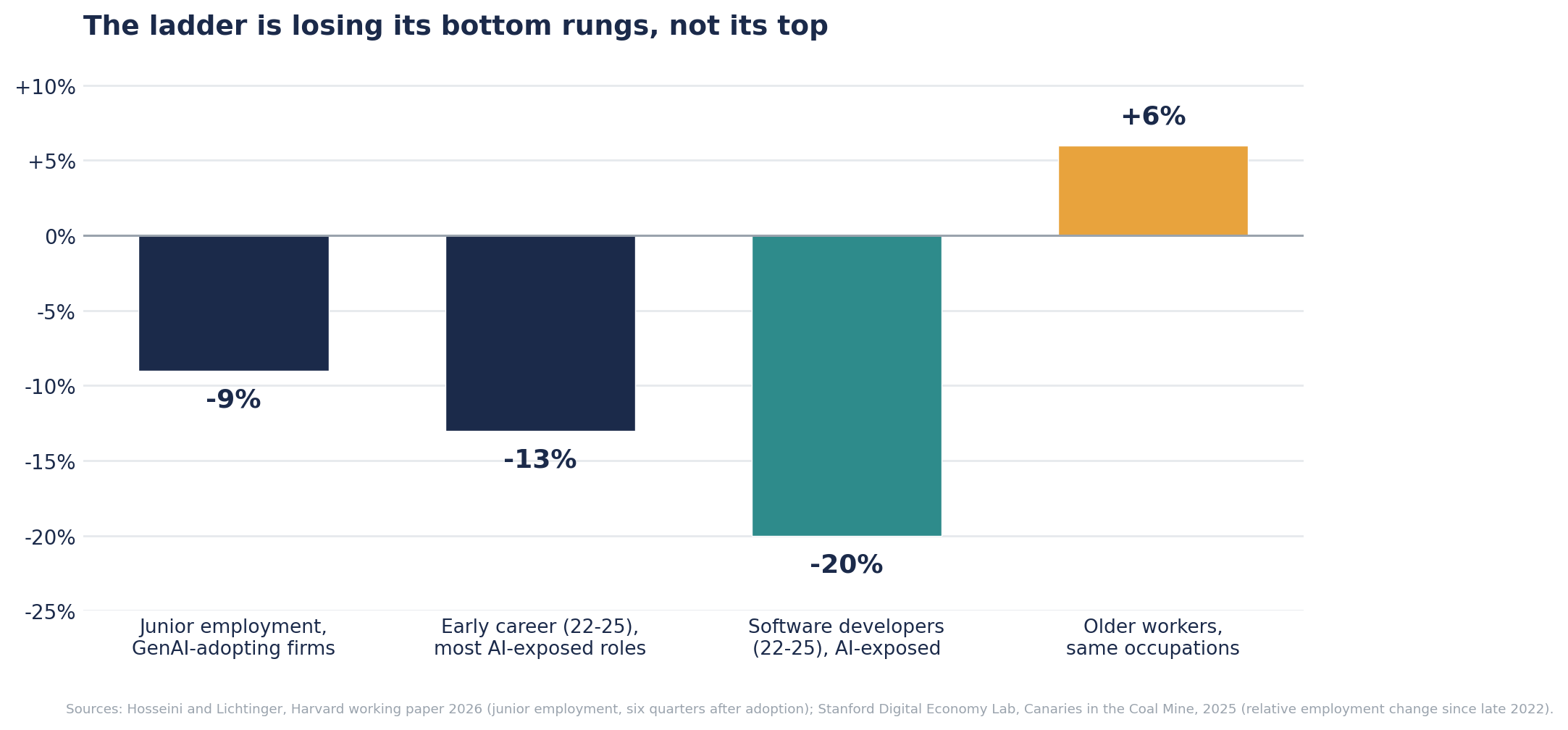
The shape of that chart is the entire argument. If AI were simply reducing headcount, the bars would move together. They do not. The decline is concentrated precisely where codified, checkable, textbook-learnable work sits, and that is the definition of an entry-level role. Pay data points the same direction: analysis of AI-exposed firms found starting wages fell around 4.5% after ChatGPT’s launch, with a steeper 6.3% drop for junior positions and stable or rising pay for senior hires. The market is repricing experience upward at exactly the moment it stops manufacturing any.
💡 Key Insight: The tasks AI absorbed first were never valuable for their output. They were valuable because they were the tuition. Nobody was paying a graduate analyst for the reconciliation itself. They were paying for the twenty-fourth reconciliation, where the analyst finally sees why the number is wrong before the model does.
Four things break when the bottom rung disappears
1. The work that taught judgment was the most automatable work. Early-career roles were built from research, first drafts, documentation, reconciliation, and routine analysis. These tasks are unglamorous, high volume, and structured, which is exactly the profile this series has repeatedly identified as the highest-yield AI target. That was correct advice and remains correct. What almost no business case captured is that these same tasks carried the context, repetition, and feedback through which a professional learns how decisions actually get made, when to escalate, and what a wrong answer looks like before anyone else notices.
2. Review-first work inverts the learning sequence. The common response is to redefine the junior role as reviewing AI output. This sounds like an upgrade and is closer to the opposite. Reviewing asks someone to detect error before they have ever produced the thing well enough to know what error feels like. You cannot audit a forecast you have never built, and you cannot spot a flawed argument in a structure you have never had to construct yourself. Review is a downstream skill presented as an entry-level one.
3. Verification is a senior capability, and the pipeline that produced it is the one being cut. An earlier post in this series argued that human oversight, not model capability, is the binding constraint on scaling AI. That argument assumed a supply of people qualified to verify. A CHI 2026 study found AI assistance is weakest exactly where tacit, specialist knowledge matters, in settings where output cannot be easily checked because the expertise lives in people’s heads. It is a single small study and should be treated as directional, but it names the trap precisely. The more autonomous the systems become, the more verification capacity the enterprise needs, and the fewer people it is training to supply it.
4. The cost lands two CEOs later, so nobody owns it. A thinner bench does not show up in this year’s EBIT or next year’s. It shows up in seven to ten years as unfilled senior roles, longer time to competence, expensive external hires for positions that used to be filled internally, and a management layer that has never done the work it now supervises. No current executive is measured on it, no business case models it, and no restructuring deck contains a line for it. That is why it is happening at scale without anyone deciding to do it.
⚠️ Watch Out: If your workforce plan treats entry-level roles purely as a cost line, you will automate them on schedule and discover the consequence long after the executives who approved it have moved on. The efficiency is real and immediate. The liability is real and deferred, which is precisely why it goes unpriced.
Europe has already written the oversight requirement into law
For European leaders this is not only a talent question. It is a compliance question with a date attached.
Under Article 26 of the EU AI Act, deployers of high-risk AI systems must assign human oversight to natural persons who have the necessary competence, training and authority, together with the necessary support. Article 14 sets the standard for what that oversight must be capable of doing, and for certain systems requires separate confirmation by two qualified persons. The Article 4 AI literacy obligation has applied since February 2025, and the deployer obligations under Article 26 become applicable on 2 August 2026. The regulation is explicit that oversight competence is a higher bar than general AI literacy. The overseer needs specialised knowledge of the system in question.
Read that alongside the hiring data and the problem states itself. The AI Act assumes a standing population of people qualified to exercise judgment over automated decisions in your domain. Competence of that kind is accumulated, not appointed. An organisation that has spent three years thinning the roles where domain judgment was built is going to find the named-person requirement considerably harder to satisfy than it looks on a compliance checklist.
The German picture sharpens this further. The Institute for Employment Research projects that the number of economically active people in Germany will fall from 47.1 million in 2023 to around 46 million by 2040, with the baby boomer cohort retiring through to 2035. German industrials are therefore constricting the entry pipeline at precisely the moment the exit pipeline opens widest. The dual training system that made German engineering depth possible was never primarily a recruitment channel. It was a judgment transfer mechanism, and it is being quietly disinvested in by firms that would never describe the decision that way.
What the organisations getting this right do differently
The ones handling this well are not hiring more juniors out of sentiment. They are separating two things that entry-level work had always bundled together, and being deliberate about which one they automate.
-
Distinguish output-producing tasks from judgment-producing tasks. Run this at role level, not function level. For each early-career role, list the tasks and mark which ones exist because the work needs doing and which ones exist because that is where someone learns to see. Automate the first category aggressively. Treat the second as developmental infrastructure with a protected budget line. Most organisations have never made this distinction explicitly, which is why it gets resolved by default.
-
Redesign entry-level roles around supervised production, not review. Juniors should still produce, at lower volume and higher scrutiny, on work where AI could have done it faster. The inefficiency is the point, in the same way a flight simulator is deliberately inefficient. Then have them compare their output against the model’s and defend the difference. That exercise builds the discriminating judgment that review-only roles never develop.
-
Make coaching a measured obligation of the manager. Deloitte’s 2026 Human Capital Trends research argues AI is reshaping how workers learn in the flow of work, which makes manager-led learning more important rather than less, because tools accelerate output while leaving people unclear on how expert decisions are reached. This series has made the same point twice about training and activation. Managers determine whether individual capability becomes organisational capability. Put decision walkthroughs and work reviews into the manager’s objectives, with a stated cadence, or they will lose to delivery pressure every quarter.
-
Put bench depth on the risk register with a named owner. Not in the HR strategy deck. On the enterprise risk register, alongside supply chain concentration and key person dependency, with a named executive accountable and a reported metric: internal fill rate for senior roles, and time to competence for critical positions. Risks that are not owned and not measured do not get managed, and this one has a decade-long fuse.
✅ Leadership Action: McKinsey’s State of Organizations 2026, surveying over 10,000 leaders, concludes that for every dollar spent on AI technology, organisations should invest five in people. Before your next AI business case is approved, ask what share of its total budget is allocated to building the capability that will supervise the system in five years. If the answer is nothing, the case is incomplete rather than efficient.
The leader’s 30-day move
A concrete sequence before the next workforce planning cycle is signed off.
-
Week 1. Pull the last three years of hiring by seniority band, split by function. Compare the trend in functions with heavy AI deployment against those without. Most organisations have never looked at this cut, and it is usually available in 48 hours. The pattern is either there or it is not, and you should know which.
-
Week 2. Pick the two functions where domain judgment takes longest to build, typically engineering, underwriting, quality, or regulated operations. Map the developmental path in each: what does someone do in year one, year three, year five that makes them capable in year ten? Mark every step on that path that AI has already absorbed or is scheduled to absorb.
-
Week 3. For those functions, redesign the entry-level role around supervised production with explicit judgment checkpoints, and name the manager accountable for coaching cadence. One role, one function, documented.
-
Week 4. Add bench depth to the enterprise risk register with a named owner and two reported metrics. In parallel, cross-reference your EU AI Act high-risk inventory against your named oversight persons and ask a blunt question for each one: where does the next qualified overseer come from, and are we still producing them?
The consultant’s takeaway
Every enterprise in Europe is currently running an unpriced trade. It is exchanging a visible five-year cost reduction for an invisible ten-year capability reduction, and it is doing so without a decision ever being made, because no single business case contains both sides of the ledger.
The uncomfortable question underneath the data is simple. How does anyone become senior if they can no longer be junior? Organisations do not answer that question by hiring more graduates or by slowing AI adoption. Neither is realistic and neither is right. They answer it by working out which of the work they are automating was training in disguise, and rebuilding that specific function deliberately, rather than assuming it will survive the removal of the tasks that carried it.
For German and European industrials this is more urgent than for most, and the reason is arithmetic rather than culture. The retirement wave is already scheduled, the workforce is already contracting, the AI Act already requires named humans with demonstrable competence to oversee high-risk systems from August, and the pipeline that would have supplied those humans is being thinned right now for reasons that look entirely rational quarter by quarter. The firms that look well run in a decade will not be the ones that automated entry-level work fastest. They will be the ones that understood what that work was actually for before they removed it.